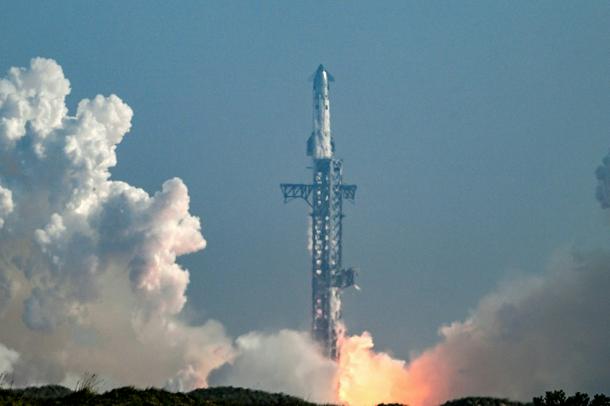
SpaceX is preparing its stock market debut -- and everyone wants a piece of the action
New York (AFP) - As SpaceX prepares its long-awaited stock market debut, investors everywhere are scrambling to get a piece of the action – through investment funds, related company stocks, and even online prediction markets.
”$14 billion has poured into SpaceX linked funds since Musk confirmed the IPO…The hype is unlike anything I’ve seen,” said an X post from Gagola Value Capital, run by two British amateur investor brothers.
But not everyone can get in yet.
Until the IPO, which is expected on June 12, the only people who can buy SpaceX shares directly are large financial players such as banks and pension funds, or very wealthy individuals.
Everyone else has to find workarounds.
One option is the so-called secondary market, where employees and early investors who already own shares in SpaceX can sell them to others privately, at whatever price the two sides agree on.
Another option is exchange-traded funds, or ETFs – investment vehicles that anyone can buy on the stock market.
Some of these funds have found ways to invest in SpaceX. By buying into the fund, an ordinary investor gets indirect exposure to SpaceX’s performance.
“We’ve increased assets under management by five times, and I’m fairly certain we have the largest percentage weight in SpaceX now of any ETF,” said Joel Shulman, founder of ERShares, whose XVOR fund has roughly 15 percent of its holdings in SpaceX.
“This is by far the most exciting IPO that we’ve seen,” he said.
But the investment in SpaceX itself is through a legal structure that holds the actual shares, a complicated mechanism that puts some investors off.
- Private so long -
The approaching initial public offering is meeting a lot of pent-up demand for a company that founder and CEO Elon Musk has kept in the headlines – and out of the public markets – for 20 years.
“What is unusual about SpaceX is the scale of the enthusiasm and the fact that such a large and influential company has remained private for so long,” said Ludovic Phalippou, a professor at the University of Oxford’s Said Business School.
“Today, investors are competing intensely to buy access to a company after much of the growth has already occurred,” he added.
By the time the public gets a chance to buy in, many of the biggest gains – the kind that made early Google or Amazon investors rich – may already be history.
“The irony is that many investors appear willing to pay a premium simply for the privilege of gaining access,” he added.
For Phalippou, this wave – which is driving prices through the roof – raises questions about the valuation of SpaceX, which is targeting $1.75 trillion.
That valuation is widely seen as far from the reality of SpaceX’s current business, but based on the faith that Musk will deliver on science fiction-like promises that the company will get to Mars and put data centers into space.
“A great company doesn’t necessarily mean a great investment,” said Jay Ritter, an IPO specialist at the University of Florida.
“A company can be a great company, but if the valuation is too high, eventually it’s going to come down to Earth. And this is where I’ve got a concern about SpaceX,” he added.
Some are managing to get into SpaceX’s orbit by buying shares in other aerospace companies.
Launch company Rocket Lab has seen its market capitalization nearly triple in two months, while satellite internet specialist AST SpaceMobile has gained 78 percent in two weeks.
Others are betting on Virgin Galactic, whose space tourism business model raises questions but which has the advantage of a stock ticker (SPCE) very close to SpaceX’s (SPCX).
Some traders are counting on a mix-up by certain investors between the two companies, which would benefit Virgin Galactic.
The last and smallest entry point is prediction platforms, through which investors can place money on a hypothesis.
The largest such platform, Kalshi, told AFP that $29 million have been wagered on SpaceX-related questions, from Musk’s net worth at end-2026 to the possibility of a Mars landing before 2030.