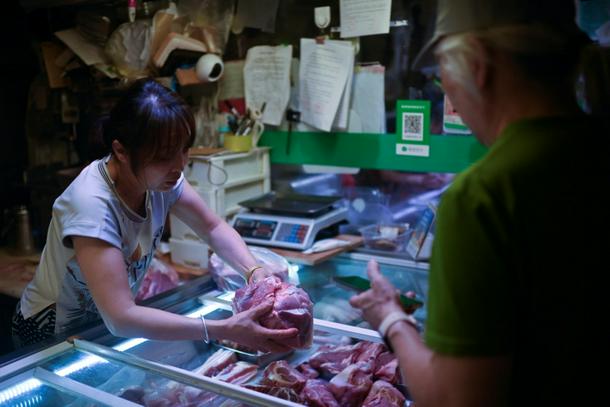
China is the world's leading consumer of pork
Beijing (AFP) - China will impose anti-dumping duties on European Union pork imports for five years, but at lower rates than temporary levies in place since September, Beijing announced Tuesday.
The two economic powerhouses have been locked in a trade spat fuelled by what many European countries view as an unbalanced economic relationship with China.
The levies come after a probe launched by China last year concluded that European pork imports “were being dumped, and the domestic industry suffered substantial damages” as a result, the commerce ministry said in a statement Tuesday.
The duties will range from 4.9 percent to 19.8 percent – down from temporary levies of 15.6 percent to 62.4 percent – and will be applied from December 17, it said.
“At present, the domestic industry is facing difficulties, and there are strong calls for protection,” a commerce ministry spokesperson said.
They added that the investigation’s conclusions were “objective, fair, and impartial”.
The agriculture minister of Spain – Europe’s top producer of pork and its derivatives – said Spanish exporters faced an average duty of 9.8 percent, below an overall average of 19 percent.
The measures were therefore “acceptable” for Spain and the result “minimised”, Luis Planas told reporters in Madrid.
China, the world’s leading consumer of pork, imported 4.3 billion yuan ($600 million) in pork products from Spain alone last year, according to official Chinese customs data.
France, meanwhile, exported 115,000 tonnes of pork to China in 2024, according to industry association Inaporc.
According to the new measures, Groupe Bigard, a major French pork producer, will be charged 9.8 percent, while Danish Crown will be hit with an 18.6 percent levy.
- ‘Bargaining chip’ -
The current trade spat erupted last summer when the EU moved towards imposing hefty tariffs on Chinese electric vehicles, arguing that Beijing’s subsidies were unfairly undercutting European competitors.
Beijing denied that claim and announced what were widely seen as retaliatory probes into imported European pork, brandy and dairy products.
Giuseppe Aloisio, general director of the Spanish meat industry association Anice, told AFP the measure was “unfair” and “punishes an exemplary industry for no reason”.
It was “unacceptable that our sector is used as a bargaining chip in a trade dispute – that of electric vehicles – that has absolutely nothing to do with us,” said Aloisio.
“The geopolitical backdrop is obvious and we believe that transferring trade tensions to the food chain benefits nobody.”
European producers criticised the imposition of temporary duties on pork in September, denying the dumping allegations.
They argued that Chinese consumers pay more than Europeans for products that the latter often ignore, such as pigs’ trotters or ears.
The EU ran a trade deficit of more than $350 billion with its key commercial partner China in 2024.
French President Emmanuel Macron said this month that Europe would consider adopting strong measures against China, including tariffs, if the trade imbalance was not addressed.
Alongside trade frictions, China and the EU are at odds on issues such as Russia’s 2022 invasion of Ukraine.
The EU has urged China to exert pressure on Moscow to end the war, but Beijing has shown no sign of acceding.