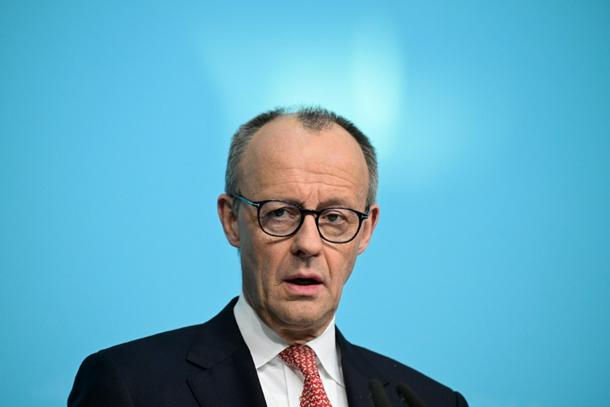
German Chancellor Friedrich Merz tours the Gulf region until Friday
Berlin (AFP) - German Chancellor Friedrich Merz headed to Saudi Arabia on Wednesday to kick off a Gulf tour as the biggest EU economy seeks to diversify its key trade and energy partnerships.
In a turbulent world where US President Donald Trump has rocked long-standing transatlantic security and economic ties, Germany is racing to cement alternative relationships worldwide.
Joined by a business delegation, the conservative leader will meet with Saudi Crown Prince Mohammed bin Salman, then travel to Qatar and the United Arab Emirates on a whistlestop tour that concludes Friday.
“We need such partnerships more than ever at a time when major powers increasingly determine politics,” Merz said before boarding his plane, adding that the Gulf could also help Germany “diversify our oil and gas supply chains”.
“Our partners may not all share the same values and interests, but they do share the understanding that we need an order in which we can trust agreements and treat each other with respect.”
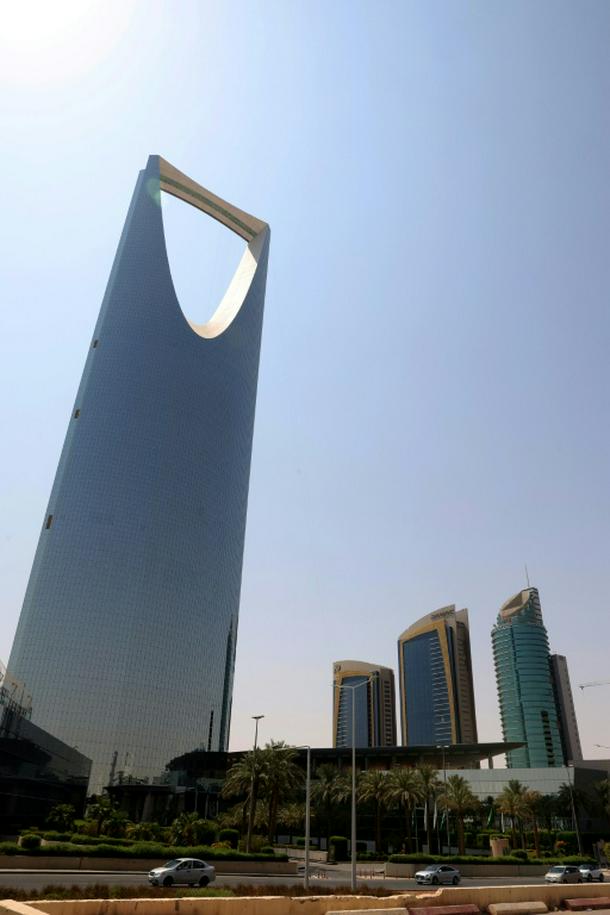
The Kingdom Centre skyscraper in the Saudi capital Riyadh
Germany has long exported defence goods and sealed major infrastructure deals in the Gulf region, whose monarchies have in turn used their energy riches to invest in German corporate giants from Volkswagen to Deutsche Bank.
When Russia’s 2022 full-scale invasion of Ukraine led to sharply lower Russian energy supplies, Berlin turned to Doha to step up liquefied natural gas imports that got it through the following winter.
Berlin has now accelerated efforts to lessen its reliance on American LNG and wants to increasingly bank on green hydrogen generated through clean energy to achieve its climate targets.
Saudi Arabia and other Gulf states have meanwhile been moving to diversify away from oil and gas, investing heavily in sectors from renewables to tourism, logistics and AI.
Merz said that Saudi Arabia’s Vision 2030 project “promotes an ambitious modernisation of the country -– economically, culturally and socially. Much progress has been made. Certainly, much remains to be done, particularly regarding human rights. We also want to discuss this.”
- Regional tensions -
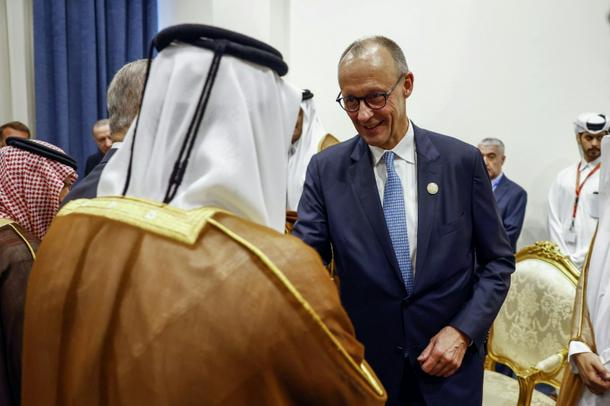
German Chancellor Friedrich Merz meets Qatar's Amir Sheikh Tamim bin Hamad al-Thani in Egypt on October 13, 2025
Merz visited India last month shortly before the EU and the South Asian giant sealed a trade deal cheered by Berlin, which is also pushing for quick implementation of an agreement with South America’s Mercosur bloc.
“For me, travelling to the vibrant Gulf region is the next logical step,” said Merz.
Andreas Lenz, an economic and energy policy expert from Merz’s CDU/CSU parliamentary group, said the Gulf held significant potential for German business.
“The region is very interested in German technology,” including in the auto, chemical, mechanical engineering and medical tech sectors, Lenz told Phoenix TV.
On the issue of whether Germany should also address human rights concerns in the region, Lenz said that any overt displays of “moral arrogance” would be “rather counterproductive”.
As an export-driven economy, Germany values stability in the Middle East, in part to safeguard key shipping lanes.
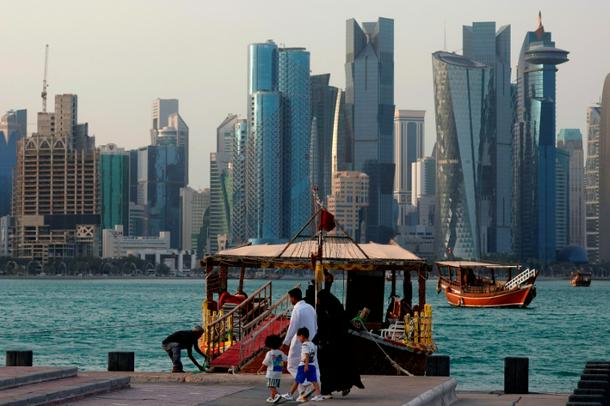
The Qatari capital Doha will be a stop on Merz's Gulf trip
Merz is visiting Riyadh, Doha and Abu Dhabi at a time of high political tensions centred on Iran after it launched a bloody crackdown on demonstrators.
Merz has not held back with voicing his disdain for the leadership in Tehran, last week condemning “a regime that can only hold onto power through sheer violence and terror against its own population”.
Before his departure, Merz again demanded that the Islamic republic must stop the violence and “halt its military nuclear programme”, which Tehran denies, as well as what Merz labelled its “destabilising activities in the region”.
Germany, with its dark history of World War II and the Holocaust, has for decades been a steadfast ally of Israel, but also criticised it for its conduct during the war in Gaza.
The chancellor said Germany aims to promote “a new peace order in the region. One day, Israel should be a welcome part of this order”.
Merz will also be visiting the UAE as it hosts the latest round of talks to end the Ukraine war, involving Trump’s envoy Steve Witkoff as well as Jared Kushner, the president’s son-in-law.