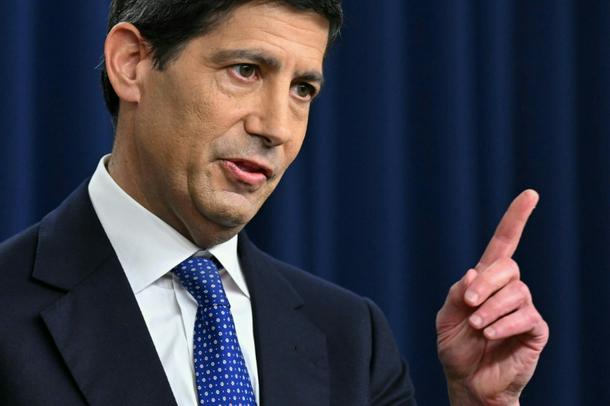
US Federal Reserve Chair Kevin Warsh said the rate hike was necessary in order to tackle stubbornly high inflation
Washington (United States) (AFP) - The US Federal Reserve on Wednesday raised interest rates for the first time since 2023, defying President Donald Trump’s demand for cuts, as central bank chief Kevin Warsh stressed the need to combat inflation that has been “too high” for “too long.”
The Fed’s Federal Open Market Committee voted unanimously to raise rates by 25 basis points to between 3.75 and 4.00 percent, saying the rate hike would support a “timelier return” to its two-percent target for inflation.
Warsh, appointed by Trump, said the decision was a “serious” one, but needed to be taken.
“The plain fact is that inflation is too high, and has been for too long,” he told a press conference.
And Wednesday’s rate hike may not be the last – the vast majority of Fed policymakers indicated that at least one more rate hike was likely necessary before the end of the year, according to their Summary of Economic Projections.
US households and businesses have been battered by years of higher-than-target inflation, and prices have surged in the wake of Trump’s war on Iran, his signature tariff policies and the ongoing AI boom.
Trump has launched an unprecedented assault on the Fed’s independence since taking office, attempting to fire a Fed Governor and launching a criminal probe against Warsh’s predecessor in his quest for lower rates to spur economic activity.
The president’s Republican Party faces a stern test in upcoming midterm elections, with rival Democrats seeking to wrest control of both houses of Congress and economic issues front-and-center for voters.
- Growing calls for hike -
The Fed has held rates steady since January, choosing to wait to gauge the effects of the Iran war’s energy price shocks and to let the impact of tariffs on prices ripple through the economy.
Since July, however, a growing faction of policymakers had indicated a rate hike may be required to tame inflation, as the war grinds on and prices remained elevated.
On Friday, August’s consumer price index came in at 3.4 percent – unchanged from the month before, but still well above the Fed’s long-term two-percent target.
Diane Swonk, chief economist at KPMG, said inflation had “forced the Fed’s hand.”
“Price pressures remain too elevated and too persistent for policymakers to look through, while the economy and labor market have held up well enough to absorb tighter policy,” she said.
In its SEP, the Fed raised its forecast for its preferred gauge of inflation – the Personal Consumption Expenditures (PCE) price index – by 0.1 percentage points to 3.7 percent by year-end.
The Fed also raised its projection for GDP growth by year-end to 2.3 percent, up 0.1 percentage points.
Warsh reiterated his belief in the “resilience” of the US economy, citing its strength as being a marker of its ability to absorb tighter fiscal conditions.
- ‘Rather unfortunate’ -
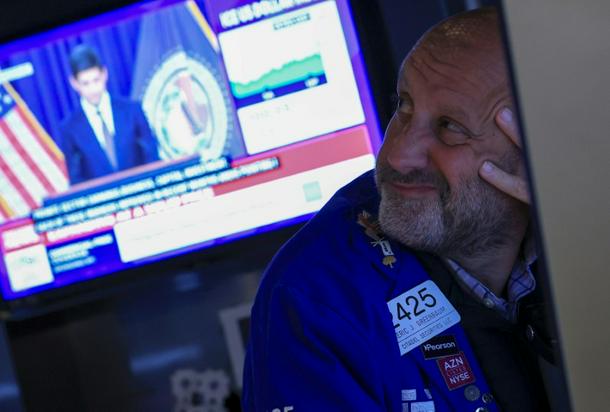
US stock markets, which had largely priced in Wednesday's rate hike, were down on the news, expected with any rate hike as equities become less attractive
US stock markets largely priced in Wednesday’s rate hike, but they were still down on the news – expected with any rate hike as equities become less attractive.
Yields on 10-year US Treasury bonds – which have surged in recent days as uncertainty on long-term inflation has spiked – were also up past the five-percent threshold, a sign that uncertainty remains a factor.
Following the Fed’s announcement, White House spokesperson Kush Desai said the decision was “rather unfortunate” and that Trump had been clear that he wanted lower interest rates.
Warsh was named to his position after a contentious Senate confirmation process, during which Democratic lawmakers accused him of being a “sock puppet” for Trump, which he denied.
So far, Trump has supported Warsh, claiming that the Fed chair wants lower rates and accusing the board of being “political.”
The Fed has a dual mandate to deliver maximum employment while keeping inflation to its long-term two-percent target.
It mainly achieves these goals by setting the key US interest rate – lower rates tend to spur economic activity but fuel inflation, and hiking them cools both activity and prices.
The Fed’s SEP showed that at least 12 of 18 policymakers who participated in the projection expected one more rate hike would be required before the end of the year.
Four policymakers expect two more rate hikes to be required.
Warsh has criticized the Fed’s policy of offering such projections in the past and did not participate in the previous iteration in June.
This projection also included only 18 policymakers, suggesting he had once again withheld his contribution.