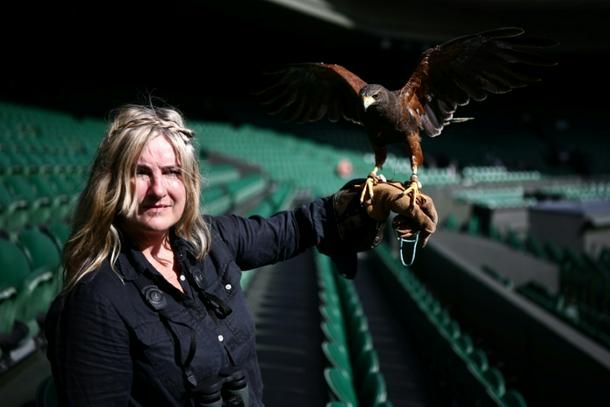
Rufus, the Harris hawk, stands on the gloved hand of falconer Donna Davis at the Wimbledon tennis club
Wimbledon (United Kingdom) (AFP) - As day breaks over Wimbledon tennis club, Rufus the hawk is poised, ready to protect the world-famous immaculate grass courts from flocks of greedy pigeons foraging for seeds.
Forget Serena and Venus, Jannik or Novak, Rufus is the real star of the prestigious London club which hosts the annual championships – the only one of the tennis majors played on grass.
And he has been patrolling the skies and the lawns since 2008, ruling the roost at the centuries old site.
Every day he can be seen flying above Centre Court – but only by the eagle-eyed who arrive between 4:00 am and 9:00 am before the public is admitted to the hallowed grounds.
“We start just as the sun’s rising and all the birds are becoming active and that’s when the best time to have a look around the grounds to see if there’s any pigeons around that may cause a little bit of problem,” his handler Donna Davis, 59, told AFP.
His job is to scare away the pigeons searching for a tasty snack, and to stop them nesting in the roofs of the club buildings.
The pesky pigeons aren’t otherwise easily put off. Even ongoing matches fail to stop them gathering on a nearby terrace to eye up what treats await below.
Pigeons “have an extremely sophisticated olfactory system, so that they can smell grass seed when it’s being sown,” said Davis.
“So this is like the caviar of the seed for the birds.”
The idea of bringing in a hawk came to Davis when she was watching a 1999 semi-final between American Pete Sampras and Britain’s Tim Henman and saw the birds fly onto the court.
Numerous attempts to shoo them away, including Sampras batting his racquet at them, failed, and the match had to be suspended.
“I was like … I can’t believe this. Every point is critical and it stops the flow of the game,” she said.
She called the club, and told them: “I think I can help you out. I have hawks and falcons that I fly.”
And so the first hawk, Hamish, was corralled into service.
- Stolen -
A test followed with the flustered pigeons flying off, convincing the club owners, and Hamish, a Harris hawk, became a fixture at the two-week championships.
When the time came, Rufus took over as chief claw patrol when he was 18 weeks old.
Now the dark brown bird with piercing eyes, measures one metre (three-feet) from wing tip to wing tip, and weighs about 700 grams.
On Centre Court he perches on the public seats on the lookout for any movement.
Even though Davis is repeatedly asked who will take over from Rufus, she rebuffs the question. These hawks can live to 30.
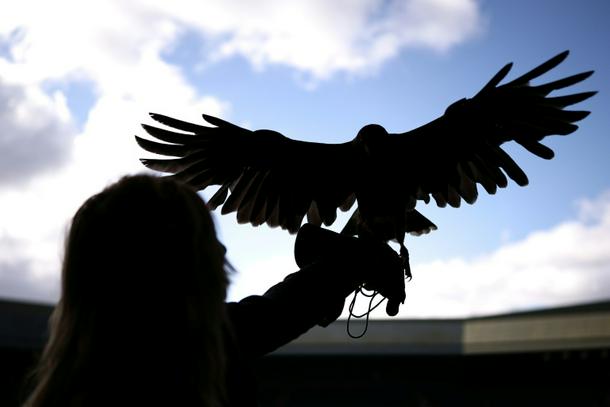
Rufus the hawk has become a media star
“I mean, people have asked here if when he pops his clogs … can he be stuffed for the museum?” Davis joked.
When he’s not at Wimbledon, Rufus chases away the birds at Lord’s cricket ground and Westminster Abbey. And when he’s not working he’s at home in central Northamptonshire.
Over the years, he’s become a media star. And he has his own Instagram account with more than 9,000 followers.
But his fame nearly cost him dearly. In 2012, he was stolen from Wimbledon when Davis had left him overnight in her van in his travelling cage.
A desperate search ensued. “We actually thought this was it, we were never going to be reunited.”
In the end journalists from the Daily Mail tabloid found him in a rescue centre in south London.
“We still don’t know what happened, but we were just more relieved that we got Rufus back,” said Davis.
The next day he made the front page of The Times newspaper with the headline “Rufus is back”.