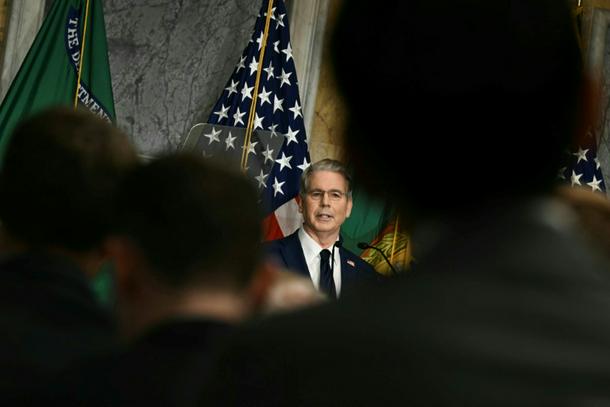
US Treasury Secretary Scott Bessent said countries that did not support the US economic campaign would 'share in the isolation' of Iran
Tehran (AFP) - Long queues formed at petrol stations in Tehran on Tuesday after the United States announced fresh sanctions aimed at pressuring Iran into submission.
Washington has turned to pulling economic levers six months into a war on Iran that has ground to a stalemate, with peace talks stalled and most traffic through the crucial Strait of Hormuz blocked.
US Treasury Secretary Scott Bessent on Monday laid out plans for the “economic asphyxiation” of Iran, saying the “objective is to sever every economic lifeline that sustains this tyrannical regime”.
Though Iran’s leaders have shrugged off the tough talk, having already endured sanctions for decades, some residents of the capital feared that they would feel the pinch.
“People are being hurt, both those who are financially well-off and those who are financially weak,” said realtor Mehdi Yazdian, 55, who urged the authorities to control prices.
“Yes, these sanctions are having an effect, but naturally, our people are resilient.”
Iran had already been grappling with sky-high inflation before the war, which fuelled an anti-government protest movement that peaked in January.
Authorities met the movement with a crackdown that foreign rights groups said killed thousands of people. The government has attributed the violence to “terrorist acts” orchestrated by the United States and Israel.
English teacher Kia Farahani, 45, said similar unrest could lie ahead.
“I personally am not afraid of war at all because this is our land,” he said.
“But I think that this war will be more economic and will cause people to feel a lot of pressure, and now maybe there will be protests again.”
Iran has carried out a spate of executions related to the winter protests, drawing outrage from US President Donald Trump, who said it was “killing protesters, even when they are not protesting, at levels not seen before”.
“It is a humanitarian crisis of epic proportions, and must be stopped, NOW,” he said on Truth Social.
- ‘Another defeat’ -
AFP images showed lines of cars snaking out of petrol stations on Tuesday after the Iranian president’s chief of staff said that petrol quotas would be reviewed.
“What is certain is that the quotas will be reduced without changing the price, but anyone who wants to buy more petrol than the quota will have a higher price,” Mohsen Haji-Mirzaei told state TV.
Announcing the new sanctions, Bessent said countries that did not support the US economic campaign would “share in the isolation” of Iran.
The Treasury Department said expanded secondary sanctions would target Iran’s digital assets and its technology, gold, aviation and shipping sectors.
The measures hit entities around the world, including in the United Arab Emirates, Hong Kong, China, Singapore and Europe.
China, a key customer for Iranian oil, said Tuesday that it opposed the sanctions and vowed to “take all necessary measures to firmly safeguard its own rights and interests”.
Bessent did not rule out the possibility of Chinese banks being targeted.
Iran, however, was dismissive of the moves and predicted “another defeat” for Washington.
“We’ve been waiting for these plans for a long time, and the government is and was ready and has a two-year plan to manage these events,” said Economy Minister Ali Madanizadeh.
- Hormuz talks -
Saeed Laylaz, Tehran-based economic expert, told AFP that the new US measures were in line with Trump’s “maximum pressure” approach, which he has pursued for years.
“The United States of America has nothing that it can do that (it) had not done before,” Laylaz said, noting years of isolation had made Iran’s economy more self-sufficient.
“But I have doubts about the internal governance of the Iranian economy” and the authorities’ ability to take concrete measures like fighting inflation, he added.
Oil prices, meanwhile, slipped for a second day on Tuesday as traders judged the risk of renewed strikes on Iran to have receded, falling around three percent to below $90 a barrel for international benchmark Brent.
Crude prices had shot up after Iran blockaded the Strait of Hormuz early in the war, and it and fellow coastal state Oman have been hammering out plans for the crucial waterway, whose closure has rattled the global economy.
The two countries’ foreign ministers met in Tehran on Tuesday, later saying they had discussed “the establishment of a joint temporary navigational corridor through the Strait of Hormuz and an agreement to implement a joint project to clear the Strait of mines”.