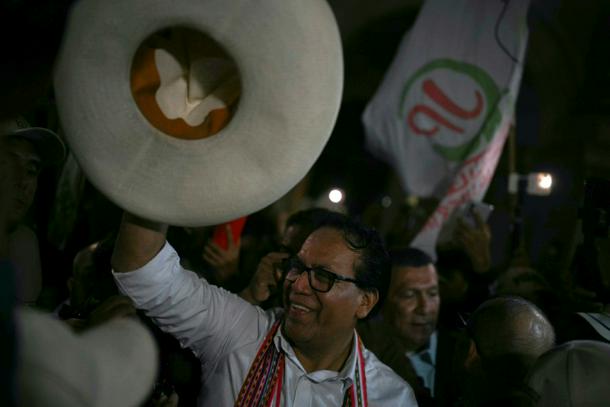
Peru's presidential candidate Roberto Sanchez, for the Juntos por el Peru party, gestures after a speech following the first results of the presidential election runoff in Lima on June 7, 2026. Voting stations closed on June 7, 2026 in Peru's presidential election, with exit polls showing four-time candidate Keiko Fujimori with the slenderest of leads over her leftist rival Roberto Sanchez.
Lima (AFP) - Leftist Roberto Sanchez pulled ahead in Peru’s presidential runoff on Monday, overtaking conservative Keiko Fujimori for the first time since counting began.
With 18 million ballots counted from Sunday’s poll, Sanchez was ahead by about 15,000 votes and the race was still much too close to call.
Many voters had hoped the election would draw a line under years of political chaos that has seen a string of presidents jailed, deposed and impeached.
Whoever is elected will be the ninth president in a decade.
But the result shows the Andean nation remains deeply divided between the populous coast and the more rural, Indigenous south.
Fujimori, 51, is hoping to ride a wave of support for right-wing candidates who have won recent elections in Bolivia, Chile and Ecuador with a tough-on-crime message.
Sanchez said Monday he was “optimistic” about the outcome but that it would be necessary to wait for 100 percent of the votes to be counted.
Fed-up Peruvians braced for days and perhaps weeks of uncertainty. The first round presidential election result took more than 30 days to complete.
“Whatever the results may be, I believe they must be respected,” said 40-year-old lawyer Andre Cossio.
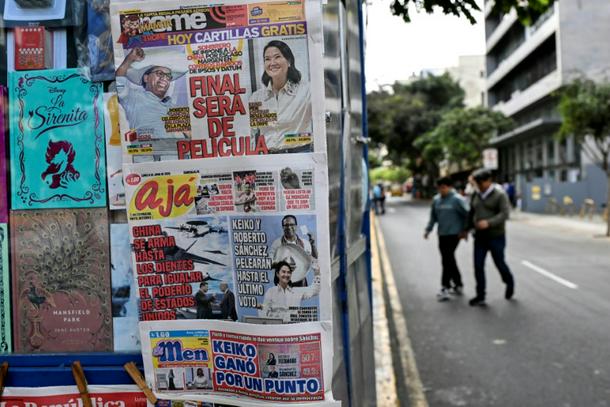
View of front pages of newspapers displayed at a newsstand in Lima on June 8, 2026, the day after the runoff election. Peru's presidential runoff was still too close to call early on June 8, 2026, with four-time candidate Keiko Fujimori all but tied with her leftist rival to become the country's ninth president in a decade.
“It is important – even in cases where votes are contested – that all possible legal remedies be exhausted.”
With 94 percent of voting centers reporting, Sanchez was on 50.043 percent and Fujimori on 49.957 percent.
Before declaring a winner, election officials will have to examine results from districts where the tally has been challenged – about 400,000 votes at stake, a process that could take several days.
Fujimori, who has already tried and failed to reach the presidency three times, insisted there will be long days ahead”.
She is the daughter of the late president Alberto Fujimori, who had been jailed for human rights violations.
“The result reflects the country’s divisions,” said Paulo Vilca, a political analyst at the Peruvian Studies Institute. “Whoever wins will have half the country against them.”
- ‘Respectful’ -

Leftist Roberto Sanchez and conservative Keiko Fujimori will face off in Peru's presidential runoff election
Sanchez, a 57-year-old former psychologist, surged late in the race to reach the runoff.
He has moderated his early calls for “radical change” and told AFP he wants a “respectful” relationship with US President Donald Trump.
On the eve of the election, a judge said Sanchez must stand trial over past financial irregularities in his party, raising claims of interference.
If he wins, he would have presidential immunity, though remain vulnerable to the country’s right-leaning legislature – which has ousted several recent presidents.
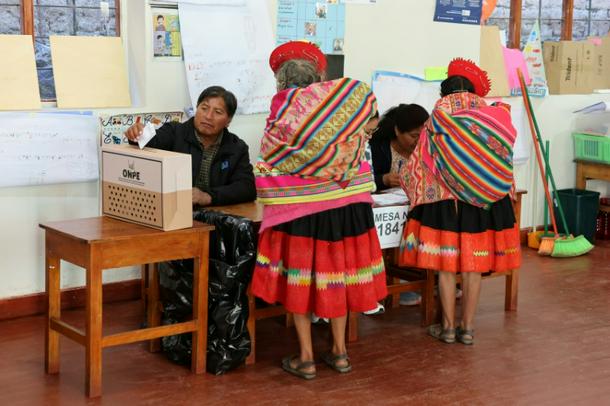
Local residents prepare to cast their vote during the presidential election runoff at a polling station in Ollantaytambo, department of Cusco, Peru, on June 7, 2026. Peruvians will choose their ninth president in 10 years in a tight runoff election between conservative Keiko Fujimori and leftist Roberto Sanchez, who are trying to woo voters fed up with political chaos and rising crime.
Sanchez has the backing of former president Pedro Castillo, a schoolteacher jailed after a failed attempt to dissolve Congress in 2022.
Sanchez is rarely seen in public without a broad-brimmed palm straw hat gifted to him by his mentor, whom he plans to pardon.
Neither Sanchez nor Fujimori will have a legislative majority and whoever wins must build alliances to complete their term, according to analyst Jeffrey Radzinsky.