
Since returning to office, US President Donald Trump has implemented stricter controls on news reporters, including deciding which journalists can cover White House events
Washington (United States) (AFP) - US President Donald Trump said Friday he was banning CNN, MS NOW and Politico from the White House, accusing them of spreading “fake news” about his administration.
The 80-year-old Republican – who has long had a fiery relationship with the media – warned that other outlets could face a similar fate but did not say which ones.
The move by Trump drew immediate accusations that it was unconstitutional and would be thrown out by the courts, while the impacted news outlets said they would not be cowed.
“I am proud to announce that, effective immediately, I am banning Fake News CNN, MSNOW…and Politico…from the White House as a result of their constant ‘reporting’ FAKE NEWS!” Trump said on his Truth Social platform.
Trump did not say what prompted the move but added that “media Outlets shouldn’t be able to constantly write or report FICTION and LIES when they’re covering the President of the United States.”
Later in the Oval Office, Trump told reporters: “I think that somebody has a right to keep them away if they’re going to write false stories all the time.”
Asked if any particular stories had sparked the ban, he replied: “It’s really just cumulative stories over the last two years.”
“You get sick of it,” he said. “They purposely write negative news, and they do that because they want to try and diminish the Republicans and a Republican administration.”
US Secretary of Defense Pete Hegseth, a former Fox News host who has brought in tight restrictions at the Pentagon, backed Trump’s new ban and accused the outlets of having “endangered troops” with unspecified stories.
- ‘Illegal assault’ -
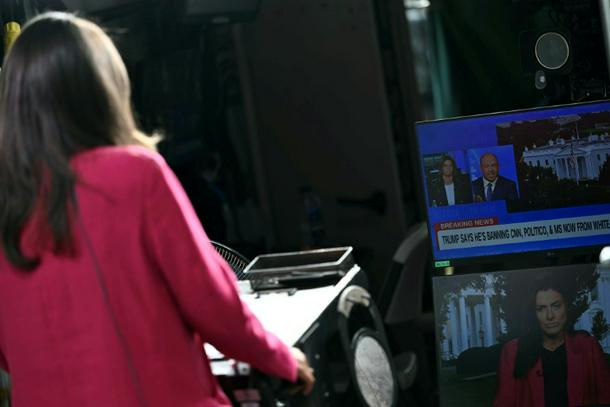
CNN Senior White House Correspondent Kristen Holmes waits to appear on-air from the CNN position on Pebble Beach, where television networks broadcast from the North Lawn of the White House
Journalists for broadcasters CNN and MS NOW – which was until recently known as MSNBC – and Politico remained on White House premises following Trump’s announcement.
Reporters for the two TV news channels could still be seen broadcasting from their stations on the White House driveway.
CNN said Trump’s ban was an “illegal assault” on US press freedom, adding that its reporting was “fair and accurate” and was protected under the US Constitution.
Politico vowed Friday to “vigorously defend our First Amendment rights against any attempt to restrict them.”
The White House Correspondents Association – the independent body representing journalists covering the presidency – said it “stands in defense” of the journalists “who are being singled out for doing their jobs.”
Both of Trump’s White House terms have seen him lash out repeatedly at media whose coverage displeases him.
He has filed multiple defamation suits against news outlets, attacked the press on Truth Social and verbally assaulted several reporters, notably women, including CNN anchor Kaitlan Collins.
- ‘Flatly unconstitutional’ -
But it is rare for US presidents to outright bar news outlets – although Trump banned CNN reporter Jim Acosta in his first term, a ban which a court subsequently overturned.
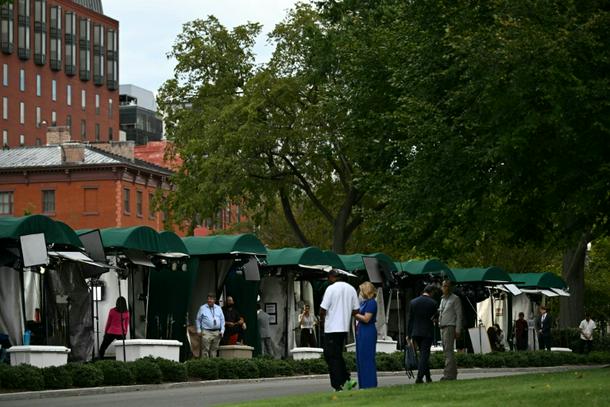
Members of the media continued to broadcast after President Donald Trump's announcement
Last year, Trump barred The Associated Press from some events because of the news agency’s decision to continue referring to the “Gulf of Mexico” – and not the “Gulf of America” as decreed by Trump.
It has also put stricter controls on journalists in Trump’s second term, including taking control of which outlets can cover events as part of the “pool” admitted to tight spaces such as the Oval Office and Air Force One.
Trump’s surprise announcement on Friday comes at a time when his approval ratings are at record lows and his Republican Party risks losing control of Congress in November’s midterm elections.
The war in Iran and rising prices, particularly at the gas pump, are among the factors that have contributed to his sinking political fortunes.
Bruce Brown, president of the Reporters Committee for Freedom of the Press, said a ban on the media outlets would be “flatly unconstitutional.”
“The First Amendment is clear that once the White House invites in some journalists, it can’t ban others because it doesn’t like their reporting,” Brown said. “This is textbook viewpoint discrimination and will be quickly struck down by the courts if challenged.”