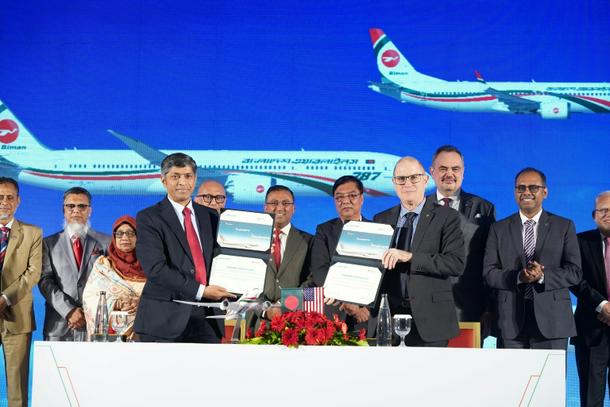
Biman Bangladesh Airlines CEO Kaizer Sohel Ahmed (L) and Boeing Vice President Paul Righi (R) exchange signed documents after signing the deal
Dhaka (AFP) - Bangladesh on Thursday signed a deal with US aircraft manufacturer Boeing to buy 14 planes for its national carrier Biman Bangladesh Airlines, the two sides announced – the airline’s biggest-ever order, in a deal valued at $3.7 billion.
Dhaka’s state-run BSS news agency called it the “biggest modern fleet expansion” for the national airline, under an agreement hammered out last year as part of a tariff deal with the United States.
The deal calls for the delivery over the next decade of eight 787-10 Dreamliners, two 787-9 Dreamliners and four single-aisle 737-8 MAX jets, the company’s “largest-ever order”, the two sides said in a joint statement.
The 787-10s will be used to serve destinations in the Middle East, while the 787-9s will be used for long-haul flights to Europe and North America.
“The new fuel-efficient, technologically advanced aircraft will modernise Biman’s fleet, sharpen operational performance, and extend its international route network,” Biman CEO Kaizer Sohel Ahmed was quoted as saying.
The contract was signed at a formal ceremony in Dhaka.
Bangladesh has a reported 19 aircraft in its current fleet, an estimated 14 of them from Boeing.
Biman currently serves 22 international destinations from Dhaka, with its longest flight linking the Bangladeshi capital to Toronto via Istanbul.
The purchase was agreed in August 2025 by the caretaker government which ran the South Asian nation of 170 million people after a 2024 revolution, until a new government was elected in February.
Bangladesh, the world’s second-biggest garment manufacturer, struck a trade deal with the United States to scale back President Donald Trump’s punishing tariffs.
The United States represents 20 percent of Bangladesh’s ready-made garments exports.
Dhaka proposed buying Boeing planes and boosting imports of US wheat, cotton and oil to help narrow its trade deficit, which Trump used as justification for imposing painful levies.
But an initial proposed 25 aircraft was slashed to 14.
The deal sparked frustration in Europe, which had been in discussion to sell Airbus planes to Bangladesh.
Trump threatened Bangladesh with 37 percent tariffs, more than double the then 16 percent on cotton products. That was scaled back to 20 percent after the deal.
Textile and garment production accounts for about 80 percent of exports in Bangladesh and the industry has been rebuilding after the deadly 2024 unrest that toppled the government.