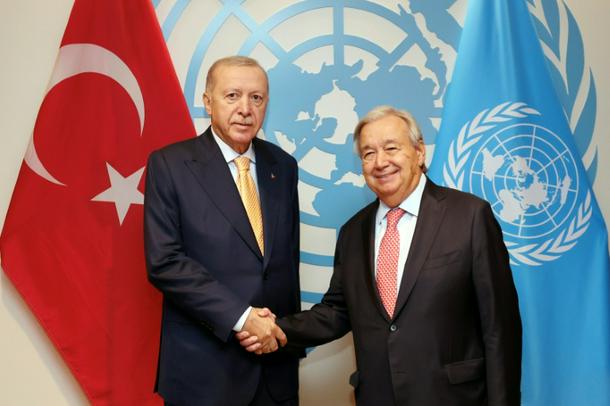
Antonio Guterres' remarks at the 'High-level Event on Climate Action and the Just Transition' were followed by Australia's prime minister, and Turkish President Recep Tayyip Erdogan
United Nations (United States) (AFP) - Outgoing UN chief Antonio Guterres on Wednesday hailed the “unstoppable” rise of renewable energy and urged countries to develop firm plans to quit fossil fuels in his final climate meeting at the world organization’s New York headquarters.
Speaking a day after denouncing “Big Oil” for treating the atmosphere like an “open sewer,” the 77-year-old secretary-general used his opening speech to sound a note of hope.
“Renewables are the cheapest, fastest, and most secure source of new electricity almost everywhere,” he said. “Clean energy has gone from alternative to unstoppable.”
He called on countries to lift their emissions cutting targets and release concrete plans to quit fossil fuels – a cause given a boost by Germany, Europe’s biggest economy, which issued its roadmap hours before Guterres’ swansong address as a summit convener.
Germany is the third country to do so, after France and the Netherlands.
“We are the first generation with the tools to end the fossil fuel age – and the last who can avert climate catastrophe,” Guterres concluded.
The former Portuguese prime minister made climate change a defining issue of his nine-year tenure that ends on December 31, and was hailed by Rachel Cleetus of the nonprofit Union of Concerned Scientists as “an extraordinary climate champion,” for consistently elevating the voices of the most vulnerable during his term.
The stakes are clearer than ever, as the impacts of climate change surge around the world – from heat waves and wildfires in Europe to catastrophic flooding in Nepal and Tibet triggered by a glacier collapse.
Extreme weather events are set to worsen with a strengthening El Nino cycle that has already tied a record for intensity, months from its peak.
And the world is set to shoot past – at least temporarily – 1.5C of warming. Scientists say temperature increases above that level will bring on worse climate-linked catastrophes.
- Turkey tempers expectations -
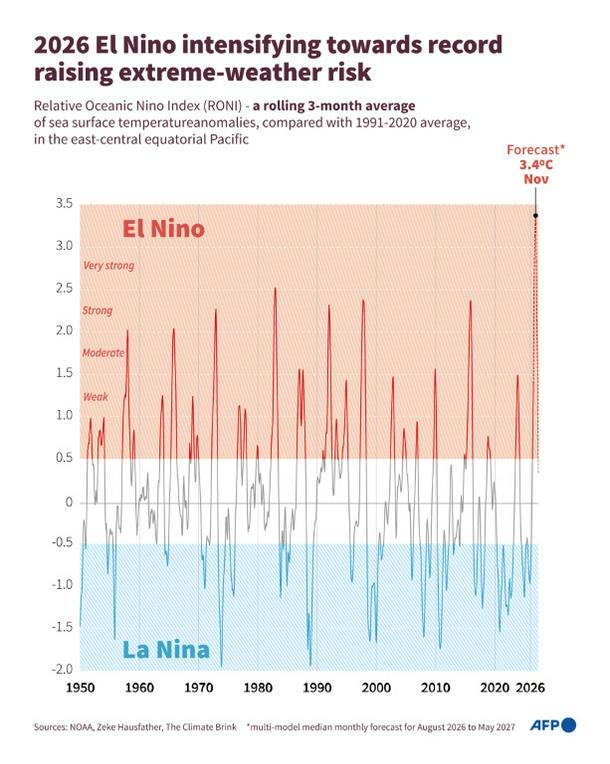
2026 El Nino intensifying towards record, raising extreme-weather risk
His remarks at the “High-level Event on Climate Action and the Just Transition” were followed by Australian Prime Minister Anthony Albanese and Turkish President Recep Tayyip Erdogan.
The two countries are co-hosting COP31 climate talks in Antalya in November in an unusual arrangement, with Australia running the talks but Turkey hosting the event and rallying support for voluntary pledges.
“Action is not optional. For Australia, as it must be for all of us, that action starts at home,” said Albanese, touting the fact that during the height of the last Australian summer, half of the power for the grid came from renewables.
Yet his climate change and energy minister Chris Bowen is traveling to India and Saudi Arabia this week for talks on strengthening Australia’s oil supplies.
Erdogan followed and appeared to temper expectations about the degree of ambition at COP31.
“Any proposal that fails to reconcile our climate objectives with social and economic realities will be doomed to fail,” he said.
- Emissions cuts, financing, electrification -
Guterres asked leaders to accelerate the greening of their economies and mobilize climate financing for developing countries. Momentum is also gathering for electrification: switching combustion-based systems, like in heating and vehicles, to electricity.
Turkey has advanced a “35x35” target to increase electricity’s share of global energy consumption to 35 percent by 2035. However, it has not specified that the electricity should be generated by renewables, which is key to tackling climate change.
Global renewable power capacity grew by a record amount last year. But as energy demand increases – not least from AI data centers and air conditioning in a warming world – clean energy is not growing fast enough to displace fossil fuels.
Pledges for Nepal – where thousands remain missing after a devastating August 26 flood – could also feature at the summit.
Nepalese Foreign Minister Shisir Khanal recently told Kantipur TV that financial support “is not a matter of charity; it is a matter of legal and moral liability” for his climate-vulnerable country, which produces negligible emissions.