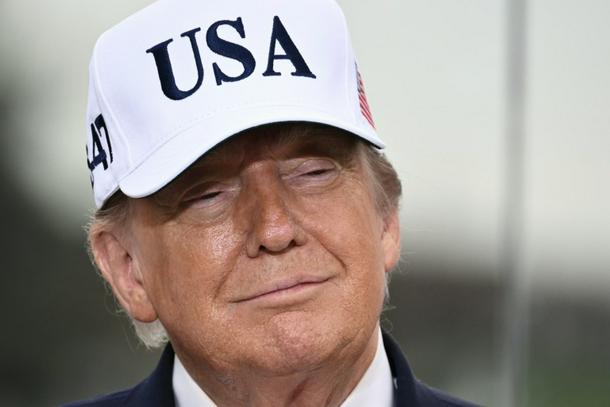
Donald Trump told Fox News host Sean Hannity 'there's a very good chance we'll make a deal' with Iran
Hong Kong (AFP) - Asian stock markets struggled Tuesday following another AI-fuelled tech selloff on Wall Street that overshadowed a possible breakthrough in talks to end the Iran war, with eyes also on the upcoming US midterm elections.
Investor fears about the vast sums being invested in the artificial intelligence complex have cast a pall over trading floors in the second half of the year, with many questioning firms’ profitability.
Earnings reports from titans including Amazon, Alphabet, Meta and Microsoft have shown they will keep pouring hundreds of billions of dollars into data centres and chips even as investors grow impatient for returns.
Monday saw Apple post forecast-topping sales and profits but warned that its gross margin – the percentage of sales left after output costs – would drop in October-December.
Earlier, leading AI firm Anthropic posted a more than 1,100 percent surge in quarterly revenue and nearly $900 billion in spending commitments as it counts down to its Wall Street listing later this month.
The investment pledges come amid a surge in borrowing costs, which have raised concerns about some companies’ financial positions owing to their huge debts, adding downward pressure to stock prices.
After a tough run last week, the selling continued at the start of this week with losses in Asian giants followed by their US counterparts on Wall Street where the Nasdaq ended 1.1 percent off.
And there was not much improvement Tuesday – Seoul-listed SK hynix and Samsung tanked five percent and 4.2 percent respectively, dragging the Kospi down more than three percent.
There were also losses in Taipei, Shanghai, Singapore, Manila, Bangkok and Jakarta, though Hong Kong, Sydney, Mumbai and Wellington edged up. Tokyo was closed for a holiday.
Even a more than seven percent plunge in oil prices Monday was unable to provide support.
The “collapse in crude should have been rocket fuel for the battered growth trade”, said SPI Asset Management’s Stephen Innes.
“Cheaper energy takes heat out of inflation, eases the rates pressure and normally gives long-duration tech a meaningful updraft.
“Instead, the Nasdaq handed back the entire opening bounce and broke Friday’s lows, a fairly ugly sign that the selling is now being driven by something deeper than oil, yields or the dollar.”
US President Donald Trump on Monday signalled progress in talks as Tehran said “intensive” exchanges were underway while offering to reopen the Strait of Hormuz under strict conditions.
“But here’s the thing: we’re dealing from total strength. We can end it at any time. If I can make a deal, I’d rather do it, save a lot of lives.”
Vice President JD Vance separately said he and the president were optimistic about securing an agreement.
Iranian President Masoud Pezeshkian announced his government had been granted more authority by the supreme leader to pursue peace talks.
The country’s parliament speaker and chief negotiator, Mohammad Bagher Ghalibaf, said “the ball is now in America’s court to prevent war”.
Crude jumped more than one percent Tuesday as the Wall Street Journal reported that US forces struck Iran’s Qeshm Island in the mouth of the Strait of Hormuz, where Iranian state media reported five explosions in rapid succession.
The Journal added that they had not been publicly announced to avoid the impression Washington intended to resume major combat operations.
And National Australia Bank’s Rodrigo Catril offered a word of caution over possible talks.
“It is worth noting that the US and Iran’s positions have not materially changed,” he wrote in a commentary.
“Iran wants US restraint and economic relief (i.e. an end to hostilities, the lifting of the US naval blockade, relief from oil sanctions and the unfreezing of at least $12 billion in assets) before delivering the concessions Washington seeks, including the reopening of the Strait of Hormuz,” he said.
“The US is demanding concessions related to Iran’s nuclear programme, but Iran wants to deal with the nuclear issue in separate talks at a later stage.
“Bottom line: for the stalemate to end, somebody needs to give ground, and it is unclear if either side is willing to do so.”
- Key figures at around 0710 GMT -
Hong Kong - Hang Seng Index: UP 0.3 percent at 23,449.66
Shanghai - Composite: DOWN 0.8 percent at 3,608.10 (close)
Seoul - Kospi: DOWN 3.6 percent at 5,648.79 (close)
Tokyo - Nikkei 225: Closed for a holiday
West Texas Intermediate: UP 1.7 percent at $98.09 per barrel
Brent North Sea crude: UP 1.6 percent at $106.51 per barrel
Euro/dollar: DOWN at $1.1192 from $1.1193 on Monday
Pound/dollar: UP at $1.3414 from $1.3410
Dollar/yen: DOWN at 157.80 yen from 157.92 yen
Euro/pound: DOWN at 83.44 pence from 83.46 pence
New York - Dow: UP 0.4 percent at 51,983.98 (close)
London - FTSE 100: UP 0.3 percent at 10,761.33 (close)