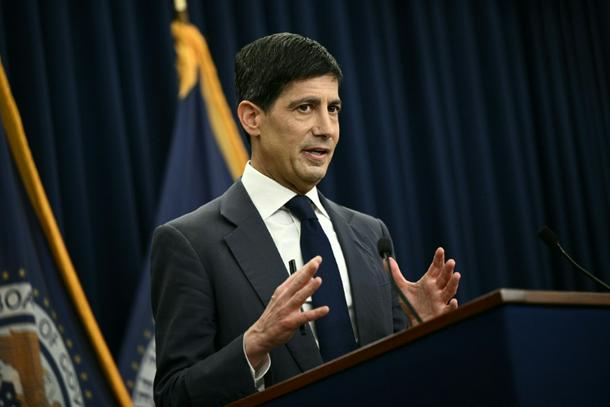
At his first meeting in charge of the US Federal Reserve, Chairman Kevin Warsh committed the central bank to achieving its price stability objective
Washington (United States) (AFP) - US Federal Reserve Chair Kevin Warsh said Wednesday the central bank was committed to fighting “too high” prices, as inflation fuelled by the US war on Iran surges through the world’s largest economy.
“We’ve all looked around and we’ve seen that prices are too high, and I don’t think I’m the only one on this stage that’s recommitted to deliver price stability,” Warsh said at a forum in Portugal, sitting alongside fellow major central bank heads.
“We’re going to deliver price stability in the US. That’s what this committee has signed up to do,” he said, referring to the Federal Open Market Committee that sets interest rates.
Chairing his first FOMC meeting last month, Warsh had delivered a similar message, with his fellow policymakers suggesting a rate hike may come later this year to combat inflation.
The Fed has a dual mandate of keeping inflation to a long-term two-percent target while also ensuring maximum employment.
Price increases, however, have been far above that level since the pandemic, peaking at nine percent in 2021.
Inflation trended down after that peak, but the US central bank paused its rate-cutting cycle in January as price volatility fuelled by US President Donald Trump’s tariffs and unpredictable economic policy rippled through the economy.
Since late February, when the United States and Israel launched the war on Iran, it has surged once more, driven by skyrocketing fuel prices.
The Fed’s preferred inflation gauge came in at a three-year high of 4.1 percent in May.
On Wednesday, Fed Chair Warsh recommitted to the central bank’s two-percent target for inflation.
“If there were people in households or the business sector, in the financial markets, who thought that this central bank was going to be comfortable with an inflation objective above two percent, well, I guess they’d be disappointed,” he said.
- AI’s potential -
In a wide-ranging panel discussion alongside the heads of the European Central Bank, Bank of England and Bank of Canada, Warsh refused to be drawn on offering forward guidance on rates, a practice he has criticized in the past.
Much of the conversation centered on the impact of artificial intelligence (AI), which has fuelled a boom in capital expenditure and on the US stock market.
“This is as exciting a time, and also as consequential a time to be a central banker that I can think of at any point, maybe outside of a crisis, in my adult lifetime,” he said of AI’s potential to spur massive economic growth.
He said the United States was likely to be a “big winner” in the early running, in part because it “is not afraid of productivity-led economic growth.”
He predicted that “jobs will be greater, prosperity will be stronger” due to AI, echoing his previous comments that many have taken as suggesting his view is that the impact will not be inflationary.
- Fed independence -
This week, the US Supreme Court blocked Trump from firing Fed Governor Lisa Cook, part of his unprecedented campaign to pressure the central bank to lower interest rates.
Trump, who named Warsh as Fed chair, also initiated a criminal probe against his predecessor Jerome Powell – one that has now been dropped.
Warsh has insisted he will not be a puppet for Trump, and on Wednesday he reaffirmed the importance of the Fed’s independence.
“So before the Supreme Court (decision), the Fed acted independently and followed its remit. After the Supreme Court ruling, the Fed will continue to do so,” he said.
“We are calling balls and strikes as best we can.”