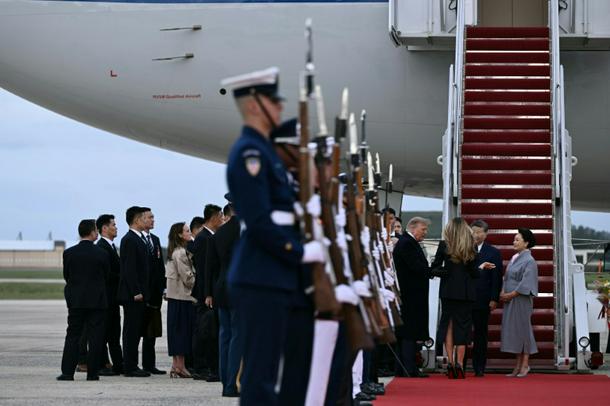
US President Donald Trump and First Lady Melania Trump greet Chinese President Xi Jinping and his wife Peng Liyuan upon arrival at Joint Base Andrews in Maryland on September 23, 2026
Joint Base Andrews (United States) (AFP) - US President Donald Trump treated Chinese President Xi Jinping to a rare personal airport welcome Wednesday, kicking off a pomp-filled state visit aimed at smoothing superpower tensions on everything from AI and trade to Iran.
Trump and First Lady Melania shook hands with Xi and his wife Peng Liyuan after the Chinese president descended from his plane at Joint Base Andrews, a US military airfield outside Washington.
Trump, wearing a long coat and gloves, and Xi then stood side by side on the tarmac as a military band played national anthems.
A noisy flyover by two B-1 bombers clearly jolted Trump, who grimaced at the roar of jets, while his Chinese guest stood by impassively.
The personal airport greeting – a courtesy Trump was notably denied when he visited Beijing in May – begins three days of pageantry that will include another flyover and a state banquet at the White House on Thursday.
Six F-22 fighter jets and six F-16s were lined up on the tarmac in an apparent display of military might as US officials literally rolled out the red carpet for the Chinese leader.
But expectations of any breakthroughs are low. Analysts say the main aim of the lavish spectacle is to maintain a fragile diplomatic and trade truce between the world’s biggest economies.
Xi was accompanied by his right-hand man Cai Qi and Foreign Minister Wang Yi, among others, according to Chinese state media.
There were no Chinese CEOs in Xi’s delegation, two sources told AFP, despite the fact that top US tech bosses including the leaders of major AI companies are set to attend Thursday’s White House state banquet.
Xi’s visit will wrap up on Friday morning when the two presidential couples have tea at the White House and then visit the National Archives, home to the US Declaration of Independence.
- Trade war truce extended -
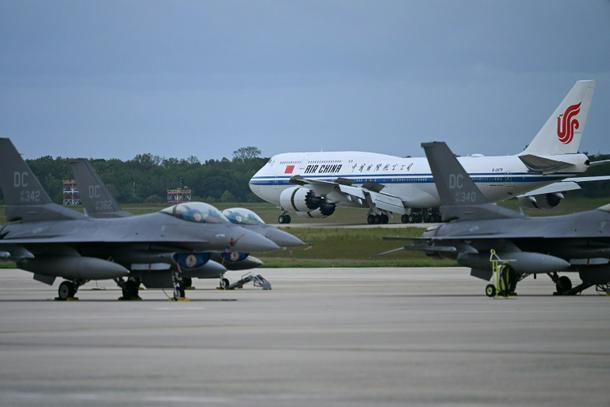
An Air China plane carrying Chinese President Xi Jinping taxis at Joint Base Andrews in Maryland
When the two leaders sit down for their highly anticipated talks on Thursday, they will be confronting a host of thorny issues led by fears – boosted by warnings from tech CEOs – that artificial intelligence risks wiping out humanity.
But with China and the United States racing for AI supremacy there are few expectations of any deal to regulate the rapidly advancing technology.
Preliminary talks on Sunday between US Treasury Secretary Scott Bessent and his Chinese counterpart He Lifeng included discussion of creating a communication channel for AI concerns.
There was one success Wednesday, when after further talks Bessent announced an extension of a truce in the simmering trade war between the world’s two biggest economies.
The “economic detente” will now extend beyond its November 10 deadline to January 10, Bessent said.
Jonathan Czin of the Brookings Institution told AFP that expectations were low for any concrete results from the meeting but “I think there will be some extension of the gentleman’s agreement.”
Analysts said that China had meanwhile begun to look past Trump, whose second term ends in early 2029, and is in many ways playing for time and using the truce to consolidate its position.
- ‘Oppressive dictator’ -
Trump’s five-star welcome for Xi has drawn criticism from China hawks within his own party, especially amid reports that Beijing supplied Iran with intelligence for attacks on US troops.
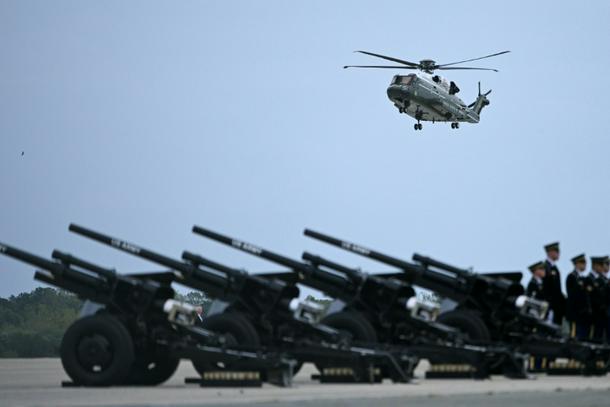
US President Donald Trump and First Lady Melania Trump on board Marine One arrive at Joint Base Andrews, Maryland
“Our commander-in-chief should keep in mind that his guest is a brutal, unelected and oppressive dictator,” said Republican Senator Roger Wicker, chairman of the powerful Senate Armed Services Committee.
Trump, however, has played down the need to bring up the allegations of Chinese help for Iran, justifying it on the grounds that both Beijing and Washington spy on each other.
For Trump, Xi’s visit is also a chance to focus on pageantry instead of problems at home, where the Iran war’s effect on fuel prices has sent his approval rating plummeting to historic lows ahead of midterm elections in November.
American presidents very rarely travel to the airport to greet foreign leaders, although Trump welcomed Russian President Vladimir Putin off his plane in Alaska last year.
The last such welcomes at Andrews – apart from papal visits – are believed to be John F. Kennedy’s welcome for British prime minister Harold Macmillan in 1962, and Dwight D. Eisenhower’s for Soviet leader Nikita Khrushchev in 1959.