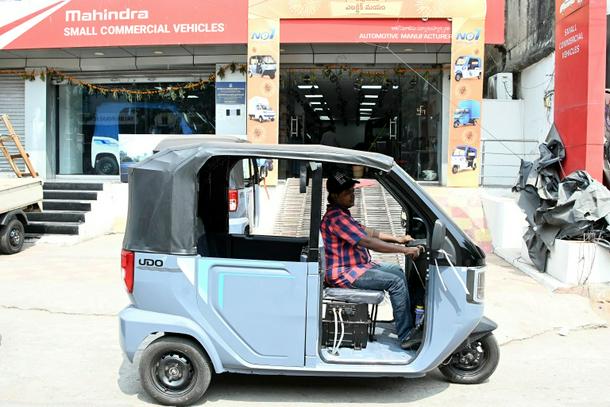
A customer driving his newly purchased Mahindra UDO electric three wheeler outside a showroom at Hyderabad, India
Hyderabad (India) (AFP) - Every 90 seconds, an electric three-wheeler rolls off the production line at an Indian factory, underscoring a transformation that has made the country the largest market for battery-powered auto rickshaws.
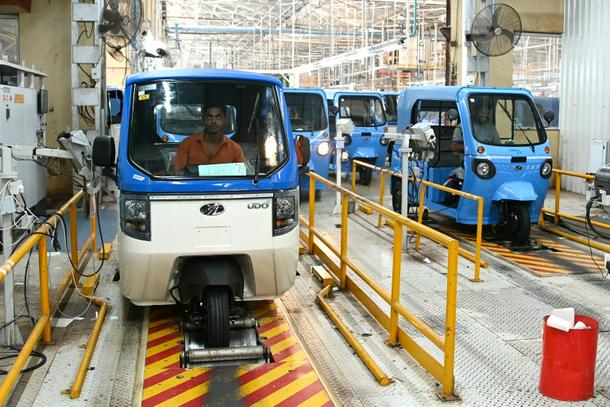
At a bustling plant run by Mahindra Last Mile Mobility, workers and robots fit cells into battery packs, attach body panels to metal frames and fix wheels into place, racing to meet demand for vehicles known for navigating the chaotic streets of the world’s most populous country.
In September, more than one in two new three-wheelers sold in India was electric, compared with about 8.5 percent of cars and 11.6 percent of two-wheelers, reaffirming its position as the world’s largest electric three-wheeler market.
“Our company has grown six times in its EV penetration in the last five years,” said Mahindra LMM’s chief executive Suman Mishra.
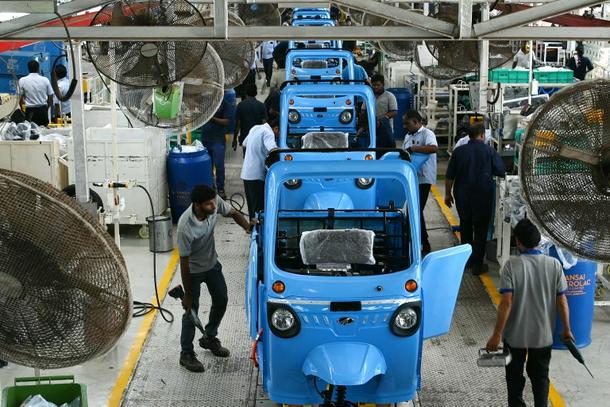
Engineers assembling electric vehicles at the Mahindra Last Mile Mobility EV manufacturing facility
She said adoption accelerated over the past two years as government subsidies, improving vehicle quality and falling operating costs combined to make ownership more attractive.
E-rickshaws first appeared on New Delhi’s streets more than a decade ago, often assembled in roadside workshops using Chinese-made batteries fitted to modified pedal-powered tricycles.
But the sector has since eaten into the market for sturdier fossil-fuel-powered three-wheelers, becoming a major industry as manufacturers such as Mahindra expand their share.
The shift has altered the look and sound of Indian cities.
Across northern India, e-rickshaws now queue outside railway stations and bustling markets, replacing the thumping noise of traditional “tuk-tuks”.
- Fuel savings -
Mahindra is one of 15 finalists shortlisted for the environmental Earthshot Prize, to be awarded in Mumbai by Prince William on November 17.
For many drivers, however, earnings outweigh environmental benefits.
“Money is coming straight into my pocket,” said Afroz Alam, a 31-year-old driver in Hyderabad who switched from a gas-powered model to an EV this year.
The cost of charging his vehicle saves him several hundred rupees a day, helping repay the loan he took out to buy the more expensive electric version.
“It may seem expensive, but then it levels out with the gas money you no longer have to pay,” he told AFP.
Analysts agree economics is the key driver of adoption, with falling costs of batteries and rising fuel prices widening the advantage of e-vehicles.
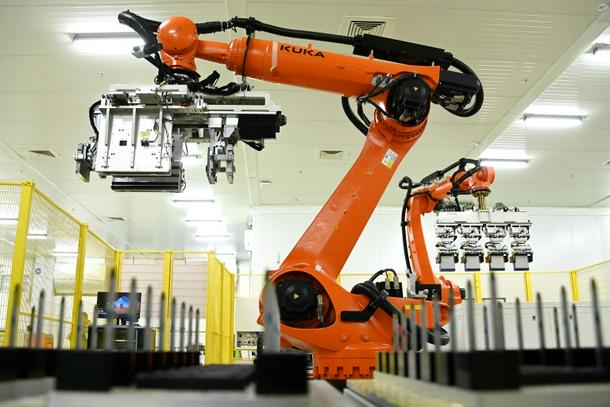
Robots assembling batteries for electric vehicles at the Mahindra Last Mile Mobility EV manufacturing facility
Indian think-tank CEEW estimated in 2025 that petrol three-wheelers cost more than twice as much per kilometre to operate over their lifetime as EVs.
“Rickshaws, which operate continuously throughout the day, accumulate fuel savings rapidly,” said Bidisha Bhattacharya of the Delhi-based Chintan Research Foundation.
The trend has also been welcomed by policymakers in India, which imports most of its oil and natural gas and has scrambled to manage energy costs, since conflict in the Middle East erupted in February.
Climate think-tank Ember said India consumes less transport fuel per capita than China did at a comparable income level in 2012, helped by the spread of cheap solar power and declining battery costs.
“In the race to curb oil imports, India is already far ahead,” Ember said in a recent report.
Yet hurdles remain, with adoption uneven across the country.
- ‘Battery will fail’ -
E-rickshaws are common in cities such as Lucknow but far less visible in Mumbai, where limited parking and charging infrastructure complicate ownership.
“In Mumbai, there is no parking at all,” Mishra said.
“So you can park on the side of the road for a (fuel-run) vehicle, but how do you do it for an EV when you have to charge it?”
Supply chains pose another challenge.
Last year, China restricted exports of rare-earth magnets, an essential component in electric motors, forcing several Indian automakers to cut or suspend production.
The bigger question is whether the success of e- rickshaws can be replicated in private cars and, eventually, trucks, which consume far more fuel
New Delhi has responded by promoting domestic manufacturing, including battery cells, most of which are still imported from China and South Korea.
“Two players are very close to commercialisation of their cells in India. We have to be patient,” Mishra said.
The bigger question is whether the success of e-rickshaws can be replicated in private cars and, eventually, trucks, which consume far more fuel.
Bhattacharya said commercial fleets could provide the next breakthrough.
When taxis transition to electric power, she said, they would help build the charging networks and consumer confidence.
For drivers already making the switch, the argument remains simple.
“They keep saying the battery will fail,” said Mohammad Ali, 26, who bought an e-rickshaw this year.
“Do a trial, take the vehicle and do it for a day. They don’t know yet how much money we are saving.”