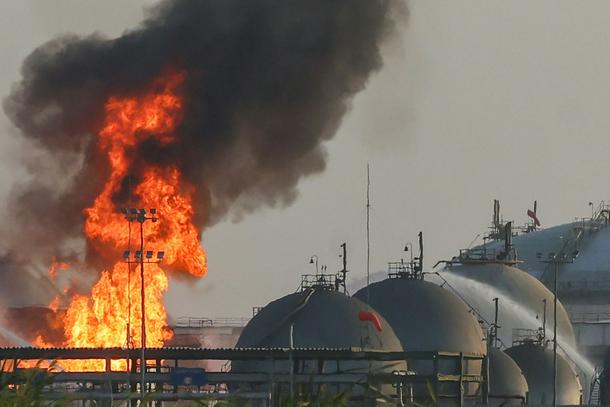
The Iran war has seen energy prices skyrocket, putting a strain on the global economy
Bangkok (AFP) - The International Monetary Fund on Tuesday forecast global growth in 2026 would slow less than previously expected because of advanced economies’ “resilience” in the face of war-fuelled energy prices, but warned low-income countries remained vulnerable to the supply shock.
In its World Economic Outlook released at the organisation’s Annual Meetings in Bangkok, the IMF raised its 2026 global growth forecast by 0.1 percentage points to 3.1 percent, compared with 3.5 percent growth in 2025.
It warned that while many advanced economies have been buoyed by rising investment in artificial intelligence (AI) technology, poorer countries that are not benefiting from that boom face stark choices as they deal with high energy prices caused by the US-Iran war.
“The global economy has been resilient, but that resilience is under strain, with risks tilted to the downside,” Silvana Tenreyro, the IMF’s chief economist, told journalists in Bangkok.
IMF Managing Director Kristalina Georgieva warned of a “real risk of complacency” during an annual gathering of the Bretton Woods Committee, “after so many shocks that didn’t push the world into a recession”.
With global debt-to-GDP ratios at sky-high levels, including in advanced economies, the IMF has called on governments to cut spending and manage borrowing – a difficult task for those in the developing world struggling with the Middle East war shock.
- ‘Bifurcated outlook’ -
Georgieva said at a panel discussion: “We have to recognise that the world that used to value only one thing, economic efficiency… now is a world in which security considerations have to be factored in.”
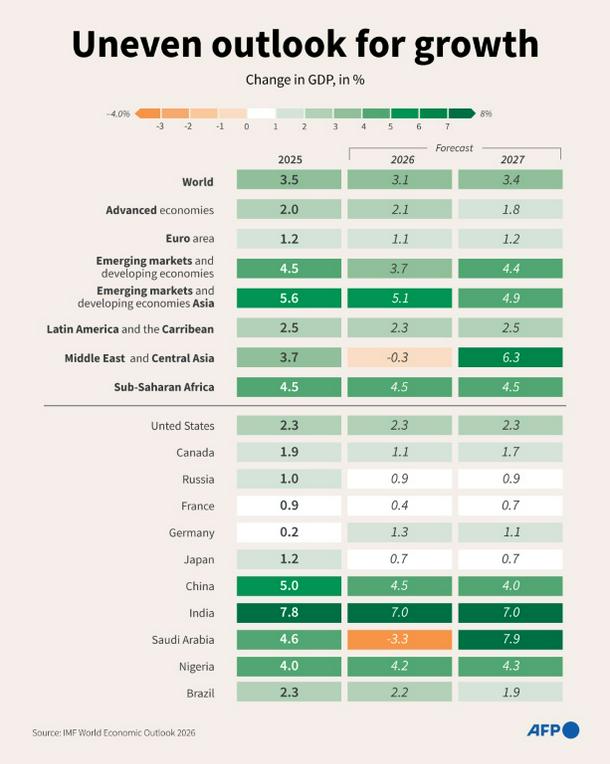
Infographic showing percentage GDP growth for selected economic zones and countries in 2025 and International Monetary Fund (IMF) forecasts for 2026 and 2027
The United States’ war on Iran, launched in February, has plunged the Middle East into violence and seen global energy prices skyrocket as a result of Tehran’s retaliation.
Prices of refined petroleum products remain between 70 and 95 percent above pre-war levels, putting pressure on countries dependent on energy imports for economic activity.
On Monday night, blasts resounded across Saudi Arabia’s capital as the war’s impact widens into that country, with Iran-backed Yemeni Houthi forces hitting oil facilities, tankers and transport hubs.
Energy-importing countries not exposed to the AI boom remain the most vulnerable, creating what the IMF termed a “bifurcated outlook” in its World Economic Outlook report.
“Headwinds from a prolonged war and persistent geopolitical tensions could revive inflationary pressures, strain fiscal and external positions, and hit energy-importing and low-income countries hardest,” it said.
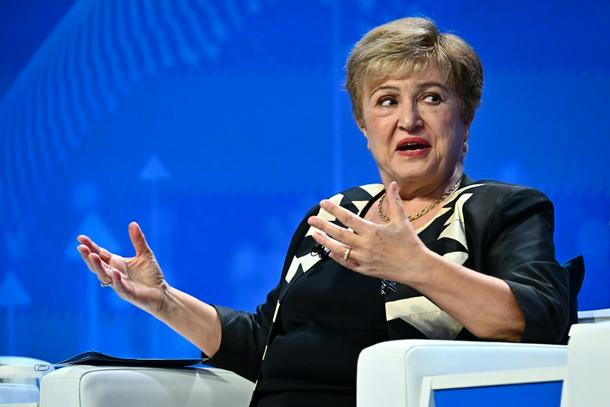
IMF chief Kristalina Georgieva says 'security considerations' have become crucial in today's world
“At the same time, the current technology tailwind could stop abruptly if expectations about AI-related profits and productivity gains are reassessed, weakening investment and tightening financial conditions.”
Responding to AFP, Tenreyro said AI had been a major factor driving the world economy, accounting for almost half of the increase in global trade from 2023 to 2025.
Georgieva said at the Bretton Woods Committee meeting that “we now have a world economy that is standing on one leg: the AI leg.”
“What if it wobbles?”
- Contraction here, growth there -
The IMF’s split view of the world economy was evident in its specific projections.
The Middle East and Central Asia region – exposed directly to the Iran war – is expected to suffer a 0.3 percent contraction in 2026.
Saudi Arabia is one of the worst affected, with its economy projected to shrink 3.3 percent – representing a 5.0 percentage point cut in the Fund’s forecast.
The IMF said the region is expected to bounce back quickly once the war is over, but there remains high uncertainty as to when that will be.
In advanced economies, growth fuelled by the AI boom and other factors remained strong.
The world’s advanced economies were forecast to grow 2.1 percent in 2026, with those in the AI supply chain such as Taiwan and South Korea posting significantly higher figures.
Growth in China, the world’s second-largest economy, was expected to slow, the IMF said, mainly because of weak domestic demand.
Global inflation remained set to accelerate to 4.7 percent in 2026, with effects spread across advanced and developing economies.
- Call for action -
Tenreyro warned that urgent action was required by all countries in the face of downside risks, and called on governments to only use temporary, targeted measures to help ease the burden on the public of high energy and other costs.
In lockstep, “monetary policy should remain firmly focused on price stability”, she added, indicating that interest rate hikes to curb high inflation were appropriate.
Georgieva told audience members at the panel discussion: “Macroeconomic and financial stability is your first line of defence. It is a source of security.”