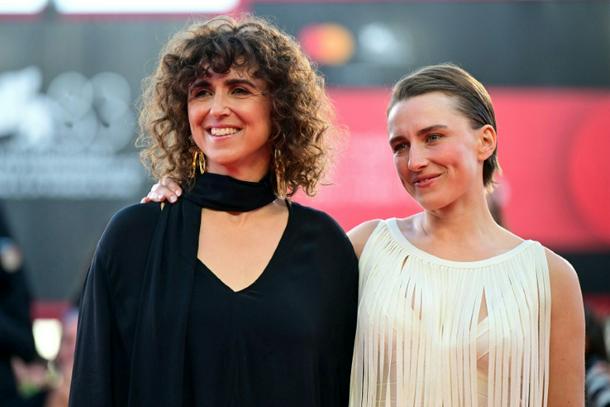
'Unknown Woman' director May El-Toukhy with the star of her film, actress Mathilde Arcel, who picked up the best actress award
Venice (Italy) (AFP) - The Venice Film Festival awarded its top prize on Saturday to a Danish-made drama about a woman trying to hide a wartime relationship with a Nazi – the only feature film with a female director in the competition.
“Woman Unknown” had been a major talking point of the festival due to its subject matter, which has rarely been explored in film, and because director May el-Toukhy was almost alone as a woman director in the event.
Only one other woman – Israel’s Rachel Szor, co-director of the chilling documentary “NAZA” about Israel’s war on Gaza – was behind the 21 films vying for prizes at the star-studded closing ceremony in Venice.
”‘Woman Unknown’ is about the female body as a battleground and a public matter. And at the same time, the film tells the tale of women who are invisible, unseen and voiceless,” el-Toukhy told the ceremony.
The head of this year’s jury, American actor-director Maggie Gyllenhaal, had questioned the dearth of women-directed films on the opening day, but she declined to discuss the issue further at a final press conference.
“I think I’m tired of talking about this same subject over and over,” she said. “I just want to celebrate a brilliantly made movie that I felt was like a laser beam.”
- Other winners -
The prize ceremony on Saturday wrapped up 10 days of often dark, disturbing programming that chief organiser Alberto Barbera had promised would echo the war-torn and anxiety-filled state of the world.
The second-place Silver Lion went to “Possible Love”, a poignant relationship study by South Korean auteur Lee Chang-dong, which was one of the most highly praised movies of the festival.
The best director prize went to Russian-born Ilya Khrzhanovsky for his vast, riotous and experimental cinema project “DAU” that chronicles the life of the troubled father of the Soviet nuclear programme, Lev Landau.
The over three-hour film began two decades ago and involved 2,000 people, many of them actors who lived for months in character on a full-scale reconstruction of a secret Soviet research institute as Khrzhanovsky filmed.
“Not everyone believed that the movie will be finished, but I always believed,” he told the audience, while dedicating the prize to the people of Ukraine “who are fighting in this terrible war for their freedom”.
The best actor award went to John Malkovich for his role as a jaded CIA agent in dark comedy “Wild Horse Nine,” which sees him take a break with a colleague on Easter Island in Chile ahead of the 1973 US-backed military coup there.
Film magazine Variety said Malkovich was “drumming up awards buzz” and tipped him for a possible first best actor Oscar at the next awards ceremony.
Best actress was picked up by Denmark’s Mathilde Arcel in her first film role as a bride-to-be who is desperately trying to hide the shame of a past relationship with a Nazi in “Woman Unknown”.
The 30-year-old told AFP in Venice she disliked fame and celebrity, but Gyllenhaal tipped her for even greater success.
“I think she is going to blow our socks off,” Gyllenhaal told reporters.
- Gaza film -
“NAZA”, by Oscar-winning Israeli directors Yuval Abraham and Rachel Szor, had been tipped by some critics for the prize for best film after a record-breaking 25-minute ovation at its premiere on Thursday.
It won a special jury prize instead, an award handed out each year by the jury to recognise an outstanding work.
In their 80-minute film, Abraham and Szor spoke to 24 different Israeli military or intelligence whistleblowers who outlined the AI-powered targeting systems used to bombard Gaza that have killed tens of thousands of civilians.
“The Israeli intelligence officers we spoke with talked to us about how this mass killing is systemic: not by accident, but by design, actions of murder and policies that are based on the total dehumanisation of Palestinians,” Abraham told the audience.
The film was described as an “urgent, gut-punch” by film magazine Screen, while The Hollywood Reporter said it inspired “outrage” and “most certainly disgust, on a profound level, for the current Israeli regime”.
The Israeli military has criticised the use of anonymous testimonies in the film, saying on Friday the identities of the whistleblowers “cannot be verified”.
Israel denies deliberately targeting civilians.