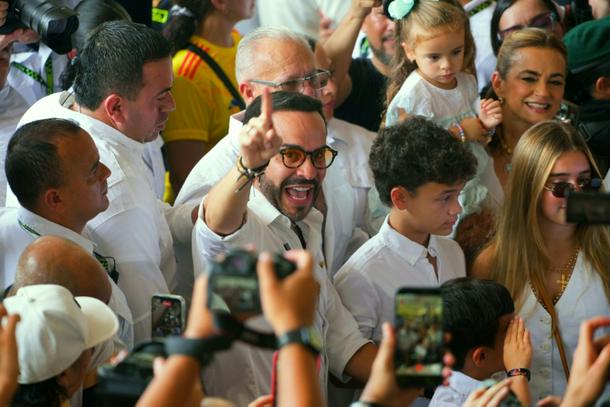
Colombia's presidential candidate Abelardo de la Espriella, of the Salvadores de la Patria movement, greets supporters as he arrives to vote with his wife Ana Lucia Pineda at a polling station during the presidential election in Barranquilla, Colombia, on May 31, 2026. Colombians head to the polls in a presidential election that will determine the conflict-ridden nation's response to spiraling violence, either staying left and opting for dialogue or tacking right towards all-out war.
Bogotá (AFP) - Colombia’s presidential election is headed for a runoff between hard‑right Abelardo de la Espriella and leftist Ivan Cepeda, presenting voters with a stark choice after the bloodiest election campaign in more than a decade.
After a race marred by car bombs, drone attacks and the assassination of a leading presidential candidate, Colombians will on June 21 decide between further peace talks and a militarized crackdown.
Colombia’s electoral authority said that with 99 percent of polling stations reporting, De la Espriella had 44 percent of the vote and Cepeda 41 percent.
A string of other candidates trailed far behind, including rightwing hopeful Paloma Valencia with less than seven percent of the vote. A candidate needs more than half the votes to win outright and avoid a runoff.
Right‑wing frontrunner De la Espriella, 47, is a pro‑Trump outsider who calls himself “The Tiger”.
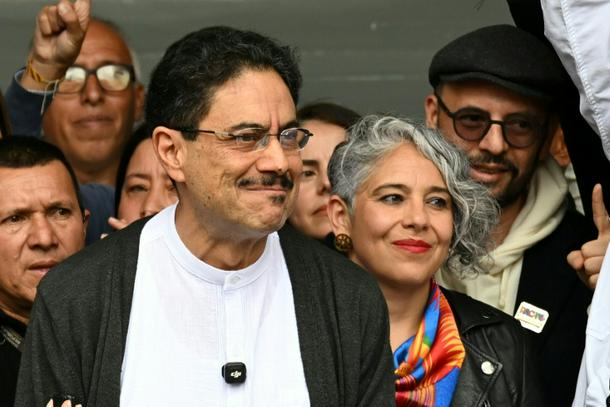
Colombia's presidential candidate from the ruling party Pacto Historico, Ivan Cepeda, speaks beside Senator Maria Jose Pizarro after voting at a polling station during the presidential election in Bogota on May 31, 2026. Colombians head to the polls in a presidential election that will determine the conflict-ridden nation's response to spiraling violence, either staying left and opting for dialogue or tacking right towards all-out war.
He has campaigned behind bullet‑proof glass and vowed to confront armed groups in the air, on land and at sea.
“We’ll start immediately with the bombing of narco-terrorist camps,” he told AFP in an interview during the campaign, sketching a “shock plan” to restore order.
A decade after a landmark peace accord was signed, pockets of Colombia remain under the control of dissident armed groups that dominate world cocaine production.
Outgoing President Gustavo Petro had championed a “total peace” strategy of negotiating with guerrillas and other drug‑trafficking groups.
Critics say Petro’s strategy has given criminal groups free rein, fueling rising violence and record cocaine exports.
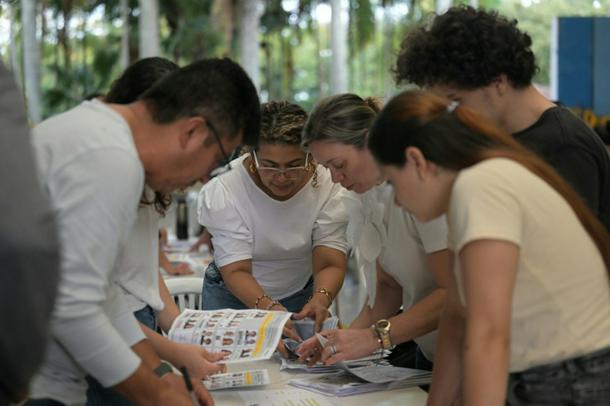
Polling station officials count ballots at a polling station during the presidential election in Cali, Colombia, on May 31, 2026.
“This government really strengthened armed groups by being so soft,” said Catalina Devia, a 42‑year‑old advertising executive and mother of two who voted for De la Espriella.
“Many Colombians are thinking about emigrating,” she said.
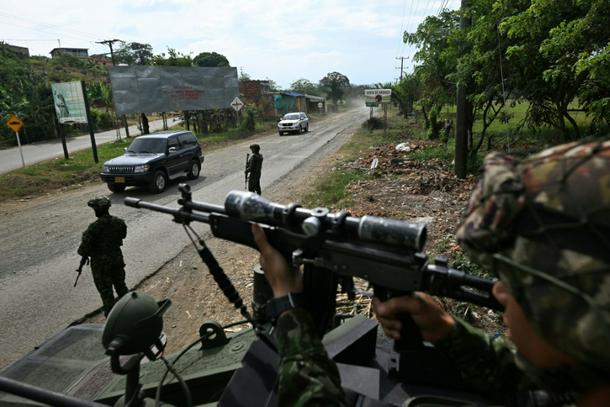
A soldier stands guard atop an armoured personnel carrier (APC) along the Pan-American Highway during the presidential election in Santander de Quilichao, Colombia, on May 31, 2026. Colombians voted on May 31 in a presidential election that could shift the country's response to rising guerrilla violence, choosing between extending spluttering peace talks or turning to a hard‑right military crackdown.
Cepeda, 63, is the son of a leftist senator killed by right‑wing paramilitaries.
He is backed by President Petro, who is constitutionally barred from re‑election, and draws support from voters who credit the government with helping the poor.
Supporters point to higher minimum wages, increased education spending and land transfers to poor communities.
“I think we’ve done quite a lot in terms of education… protecting the environment, social justice, and defending human rights,” said Pedro Barragan, a 52‑year‑old teacher voting in central Bogota.
– ‘What I fear’ –
Some voters expressed unease with the stark and polarized choice.
“My vote is not guided by what I want, but what I fear the most,” said Julian, a 37‑year‑old project manager.
“I’m going to vote for the less worse candidate.” In conflict‑hit regions, voters voiced anxiety over security but also demanded social investment.
“What do I expect from the new government? That it take Indigenous communities into account,” said Yorelis Polanco, a member of the Wayuu community near the Venezuelan border.
Despite worsening violence in rebel‑held areas, election day itself passed calmly.
Authorities deployed more than 400,000 police and soldiers nationwide to secure polling stations.
Whoever replaces Petro will face a web of armed groups engaged in drug trafficking, illegal mining and extortion.