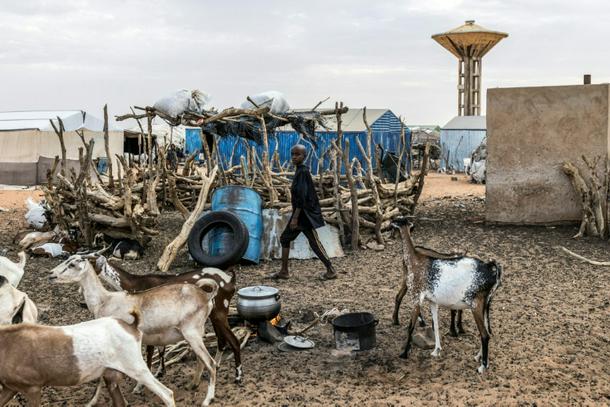
Instability has displaced hundreds of thousands of Malians, including to neighbouring countries like Mauritania (here)
Bamako (AFP) - Mali’s military leader on Tuesday made his first public appearance since unprecedented large-scale weekend attacks destabilised his ruling junta, visiting the wounded and meeting the ambassador of key ally Russia.
Jihadists and Tuareg separatists are still positioned in the vast Sahelian country’s north, three days after launching a stunning wave of attacks, in what Moscow said remained a “difficult” situation.
On Tuesday evening, the jihadists threatened to blockade the capital, Bamako.
Junta chief Assimi Goita had made no appearance or statement for three days, fuelling doubts about his ability to cling to power.
But on Tuesday his office released photos of him meeting wounded soldiers and civilians, as well as the Russian envoy.
The coordinated dawn offensive on Saturday against strategic junta positions, including areas around the capital, Bamako, killed at least 23 people, a hospital source told AFP on Tuesday.
The attacks were the largest in nearly 15 years and saw two former foes – Islamist insurgents and Tuareg separatists – join forces against the military junta and its Russian paramilitary backers.
Defence Minister Sadio Camara – seen as the mastermind behind the junta’s pivot to Russia – was killed in two days of fierce fighting.
The clashes pitted the army against Tuareg separatists from the Azawad Liberation Front (FLA) and their allies within the Al-Qaeda-linked jihadist Group for the Support of Islam and Muslims (JNIM).
At his meeting with Goita, Russian ambassador Igor Gromyko “reaffirmed his country’s commitment to stand with Mali in the fight against terrorism”, according to the Malian leader’s office.
Goita also visited wounded civilians and soldiers at a hospital in Kati, about 15 kilometres (nine miles) from Bamako, it said.
- Military withdrawal -
Russia’s defence ministry earlier said the rebels, who have captured a key town in the mostly desert north, were “regrouping”.
It confirmed that mercenaries from Russia’s Africa Corps, controlled by the government in Moscow and sent to back up the Malian junta, had been forced to withdraw from the northern town of Kidal, now under the armed groups’ control.
The assaults raise questions about the junta’s ability to tackle the security crisis, despite its insistence that its strategy, foreign partnerships and increased military efforts have stemmed the jihadist threat.
The notable absence of Goita, who seized power in 2020 pledging to combat the Islamic militants, had prompted uncertainty about the future of the country’s military leaders.
A Malian security source told AFP that Goita was not taking any risks for “security reasons”.
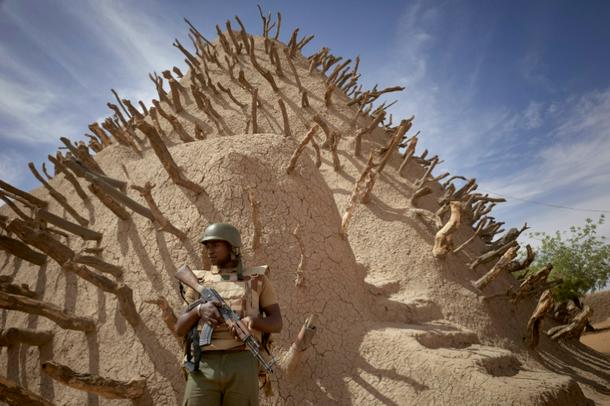
(FILES) Gao, a strategic town in northern Mali, was occupied by militant Islamists for much of 2012
In a sign of the high tensions, the army has withdrawn from several positions in the northern Gao region, local sources told AFP on Tuesday.
“The military have abandoned their position in Labbezanga, near the Niger border. They have withdrawn to Ansogo,” a local politician told AFP on condition of anonymity.
Gao is the army’s second-largest military stronghold after Kati, a garrison town near Bamako which is home to several senior junta officials and was targeted in the weekend attacks.
“Saturday’s attack on the Kati (military) camp killed at least 23 civilians and soldiers,” the hospital official said on condition of anonymity.
The towns of Kidal and Gao in the north along with Mopti and Sevare in the centre were also targeted.
- Diversion? -
On Tuesday, a JNIM spokesman released a video saying the militants were imposing a blockade “on all roads into Bamako”.
Spokesman Bina Diarra said people who wanted to leave the capital would be allowed to do so “but entering it is forbidden until further notice”.
The same applied to Kati, he said, adding: “Anyone breaching this blockade… will face the consequences.”
AFP was not able to verify whether the blockade was in place on Tuesday evening.
The US embassy in Bamako advised American citizens to stay put and avoid unnecessary movements.
The attacks near the centres of Malian power have been seen by some analysts as a diversion to seize Kidal in the vast desert north.
This pro-independence stronghold was controlled by Tuareg rebel groups for years before being retaken in November 2023 in an army offensive, supported by Russian mercenaries from Africa Corps’ predecessor, the Wagner Group.
The weekend attacks are reminiscent of a crisis that rocked Mali in 2012, when Tuareg rebels joined forces with jihadists to capture strategic hubs in the north.
The alliance between the jihadists and Tuareg rebels eventually unravelled when they turned on each other and the jihadists drove the Tuareg separatists out.
The latest attacks are the result of a new alliance between the two groups.
Although they have different goals, according to experts, they are united against a common enemy – the military junta that has ruled since 2020 and its Russian paramilitary backers.