
Thousands of protesters led by the social media-driven Cockroach Janta Party (CJP) movement rallied in New Delhi
New Delhi (AFP) - Indian Prime Minister Narendra Modi vowed “stringent punishment” on Thursday for anyone involved in leaking exam papers, a scandal that has sparked protests against his administration.
A series of irregularities has stoked public anger, including the leak of a medical entrance exam paper – forcing millions to retake the exam – and a failure in an online marking system.
The protest movement has evolved to include concerns over unemployment, opportunities for young people and what critics brand as Modi’s increasingly authoritarian style of governance.
In a social media post, Modi said that “nothing is more important than the welfare and future of our youth.”
“Those who try to harm the future of our youth will not be spared,” he added.
His post did not mention Education Minister Dharmendra Pradhan, whose resignation has been one of the protesters’ main demands.
Later in the evening, Modi said the government was working on measures to fast-track court proceedings against those involved in the leaks and that the issue would be discussed by the cabinet on Friday.
In a video address posted on X, he said he called the leaks a “matter of great pain” for hundreds of thousands of students.
A late night government notification also announced the transfer of a top bureaucrat in the education ministry to another department as part of a broader bureaucratic reshuffle.
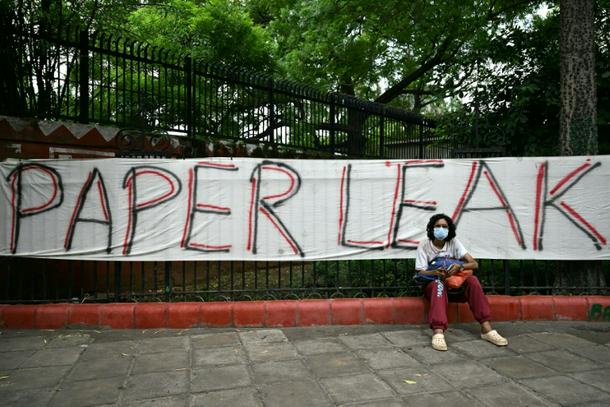
A Cockroach Janta Party (CJP) supporter sits at Jantar Mantar in New Delhi on July 23, 2026 during the ongoing protest to demand the resignation of India's Education Minister Dharmendra Pradhan
Modi’s promise comes as thousands of protesters, led by the social media-driven Cockroach Janta Party (CJP) movement, rallied in New Delhi this week.
The protests have become one of the biggest challenges for the Hindu-nationalist leader since his 2024 re-election for a third term.
The CJP, which has millions of followers on social media, said Thursday it would press ahead with its fight “to fix the system and set accountability”.
“This country has seen many announcements of fast-track courts, but this is not the solution to the systemic issues in the education system,” CJP spokesman Ashutosh Ranka said on X.
“Modi should fix the system, remove Dharmendra Pradhan and bring accountability.”
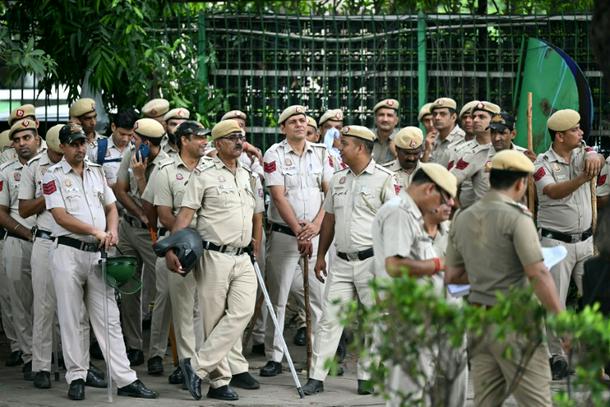
Police personnel stand guard at Parliament Street in New Delhi during the ongoing protest to demand the resignation of India's Education Minister Dharmendra Pradhan over alleged NEET exam irregularities
Aarohi Singh, a 23-year-old protester, said her sister was one of those forced to retake the medical entrance exam but did not pass.
“After the paper leaked she was demoralised and broken,” she said.
To Singh, “there’s the people of the country on one side and the (education) minister on the other.”
“Why can’t the prime minister just sack him?”
- ‘Future of our youth’ -
The Jantar Mantar protest site in New Delhi has seen bouts of unrest and violence during the week.
Crowds spilled out on streets outside Jantar Mantar on Wednesday, triggering late-night clashes with police.
On Monday, protests snowballed after police fired tear gas and baton-charged demonstrators as they tried to march to parliament.
Human Rights Watch in a statement on Thursday urged the government to investigate “unnecessary and excessive use of force, allow peaceful protests, and stop suspending mobile internet services, which put people at added risk”.
At Jantar Mantar, content creator Kaushal Malik said he had joined the demonstrations despite his family’s concerns.
“My parents support the cause but don’t want me to be here because they are afraid for my safety,” Malik, 22, said.
“They’ve asked me to be careful and not go too close to police. They’ve been calling and checking on me, and are scared just like any other Indian family.”
The protest movement has been backed by opposition parties who have been disrupting parliament proceedings and demanding an apology from Modi over Monday’s police action.
“You are the one who has harmed the future of our youth the most,” Rahul Gandhi of the Congress party said on X on Thursday, referring to Modi.
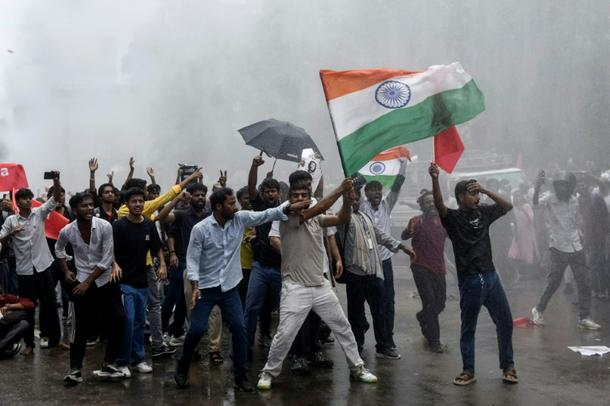
Demonstrators in Patna city, one of several locations across India that have seen protests in recent days
“You allowed and encouraged the total capture and destruction of our education system – and protected every person responsible for it.”
Engineering student Kunal Suryavanshi, who travelled to the New Delhi protest from his town in Madhya Pradesh state, said he had “come to be part of something that will hopefully lead to change”.
“All I have brought with me is hope,” the 17-year-old told AFP.
In a separate development, prominent Indian activist Sonam Wangchuk, who began a hunger strike on June 28 in support of the protesters, announced after midnight that he had ended his fast after “long negotiations on various conditions” and to avert “possible violence in the country.” He said he would describe the conditions in a separate video.
In neighbouring Bangladesh – where youth-led protests in 2024 toppled the government of Sheikh Hasina – dozens of students held a “torch rally” on Thursday evening to express their solidarity with protesters in Delhi.
“We want to express our full support for the students protesting against the commercialization of education, corruption and question paper leaks,” Rafiquzzaman Farid, coordinator of a student activist group, told AFP.