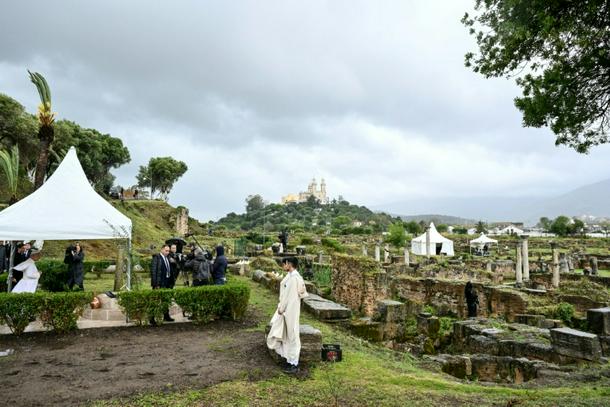
Pope Leo prays during a visit to the archaeological site of Hippo in Annaba
Annaba (Algeria) (AFP) - Pope Leo XIV arrived Tuesday in the Algerian city of Annaba, the one-time home of Christian theologian Saint Augustine, on day two of a historic trip marred by two suicide attacks.
While the authorities have yet to comment, an informed source on Tuesday confirmed the bombings, and widely circulated videos of the bodies of two suicide bombers in the city of Blida were verified by AFP.
No other deaths were confirmed.
Monday’s attacks rocked Blida, some 45 kilometres (28 miles) southwest of the capital Algiers where the pontiff began the first visit by a pope to the North African country.
The trip was already at risk of being overshadowed by a spat with US President Donald Trump, who said he was “not a big fan” of the pope after Leo called for peace in the Middle East.
Aboard the papal plane en route to Algiers, the 70-year-old American pontiff told reporters: “The Gospel says… blessed are the peacemakers.”
“I have no fear, neither of the Trump administration, nor speaking out loudly about the message of the Gospel,” he said.
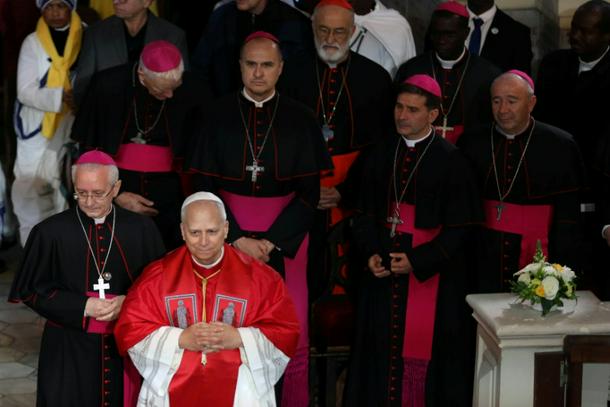
On the first day of his trip, the pope met members of the Algerian community in the Basilica of Our Lady of Africa in Algiers
The US president has also accused the pope of “toying with a country (Iran) that wants a nuclear weapon”, and on Monday doubled down on the criticism, saying he had “nothing to apologise for”.
Overnight, US Vice President JD Vance urged the Vatican to “stick to matters of morality” amid the escalating row, “and let the President of the United States stick to dictating American public policy”.
Italian and American bishops expressed their support for the pope, as did Italian Prime Minister Giorgia Meloni, known to be close to Trump. She called the US president’s remarks “unacceptable”.
- ‘Son’ of Augustine -
The controversy aside, in northeast Algeria in Annaba – formerly the ancient Roman city of Hippo – Leo visited vestiges of the city’s past, and a reception centre run by Catholic nuns for impoverished elderly people, mostly Muslims.
The city was the one-time home of Augustine, whose autobiographical “Confessions” is a seminal work within the Christian tradition.
The pontiff has previously referred to himself as a “son” of the saint, and belongs to the Augustinian order.
Leo also celebrated Mass at the hilltop Basilica of Saint Augustine in the presence of clergy from across Africa. The Arab-Byzantine-style church draws some 18,000 pilgrims each year, including Muslims and Jews.
Among those in attendance was Sister Rose-Marie de Tauzia, who has lived in Algiers for two decades. She said she was happy with the pope’s visit, adding he had come to “proclaim peace” at a time “when everything is difficult” and “the world is in tension”.
Delivering his homily in French, the pontiff told Algeria’s Christians they were “a humble and faithful sign of Christ’s love in this land”.
“Bear witness to the Gospel through simple gestures, genuine relationships and a dialogue lived out day by day: in this way, you bring flavour and light to the places where you live,” he said.
In his first speech in Algiers on Monday, Leo paid tribute to victims of the country’s 1954-1962 war of independence from France and called for “forgiveness”.
His remarks came amid heightened tensions between Algeria and France, and followed a meeting days ago with French President Emmanuel Macron at the Vatican.
The pope also urged Algeria’s leaders “not to fear” greater public participation in political life, calling for a “vibrant, dynamic and free civil society”.
Since the pro-democracy Hirak protests in 2019, which called for sweeping reforms and greater transparency, human rights groups have reported shrinking freedoms and greater controls over public space.
“Authorities are called not to dominate, but to serve the people and foster their development,” Leo said.
The pope is due to leave Algeria on Wednesday for Cameroon, before travelling on to Angola and Equatorial Guinea.