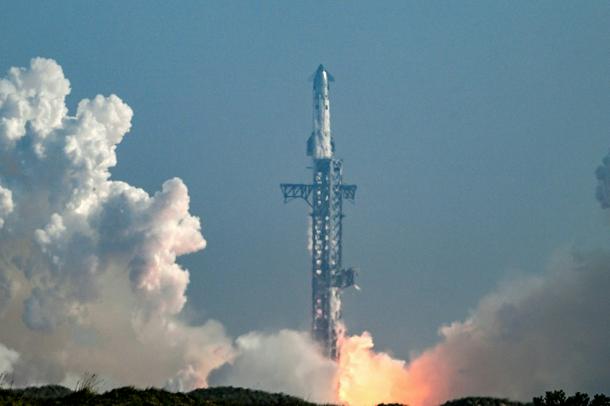
SpaceX says its 'growth strategy is highly dependent' on its massive Starship rocket, seen here in May 2026
Washington (United States) (AFP) - SpaceX, the rocket and satellite company led by US billionaire Elon Musk, aims to raise approximately $75 billion in a record initial public offering, the company said in a regulatory filing on Wednesday, valuing the company at $1.765 trillion.
SpaceX said it will put up for sale 555,555,555 shares at an initial price of $135 each.
Should the IPO proceed, Musk’s company would shatter the fundraising record previously held by oil giant Saudi Aramco, which raised $25.6 billion in 2019.
With some 13 billion shares outstanding, the company would be valued at $1.765 trillion at IPO.
- Consolidation of Musk’s empire -
It could also make Musk – already the world’s richest man – humanity’s first trillionaire, analysts say.
SpaceX took over Musk’s artificial intelligence firm, xAI, in February. One year before, xAI absorbed the X social network (formerly known as Twitter).
Analysts expect further consolidation of Musk’s business empire in 2027, when they say SpaceX will likely merge with his electric car company, Tesla, which is increasingly focused on robotics, energy and autonomous transportation.
The two companies are already jointly developing projects, including a giant semiconductor manufacturing plant known as Terafab.
In 2020, SpaceX activated its StarLink broadband operations, shaking-up the satellite internet business with fast and relatively affordable access. It now has some 10.3 million subscribers across 164 markets, the company says.
Among the many users have been Ukrainian troops and Iranian protestors.
That business has proven to be a key source of cash for the capital-intensive company as well.
- The Moon and Mars -
While SpaceX was not directly involved in NASA’s historic flyby of the Moon in April known as Artemis II, it will play a key role in the Artemis program’s future.
More than fifty years after first landing humans on the Moon, NASA hopes that SpaceX will help them do it again in 2028. Musk’s company – as well as its chief competitor, Jeff Bezos’s Blue Origin – are designing lunar landers for the mission.
While the timeline could shift, NASA has said it hopes to test an in-orbit rendezvous between its spacecraft and one or two lunar landers in 2027, with a view towards a lunar landing the following year.
The company speaks openly about its ambitions to put humans on Mars, and has even tied a massive bonus for Musk to colonizing the red planet with one million inhabitants. For his part, Musk describes his martian ambitions as key to the long-term survival of the human race.
- Not really public yet -
Until the SpaceX stock actually floats on public markets, the only people who can buy shares directly are large financial players like banks and pension funds – or very wealthy individuals.
By the time the public is able to purchase, many of the gains – the kind that have made millionaires and billionaires of early tech investors – may be history.
The extraordinary valuation is widely seen as reflecting less the reality of SpaceX’s current business than faith that Musk will deliver on science fiction-like promises that the company will reach Mars and put data centers into space.
Despite SpaceX’s public listing, Musk is expected to retain control of the company, with over 80 percent of the voting power, allowing him to “control the outcome of matters requiring shareholder approval,” according to the filing on Wednesday.
- Private spaceflight pioneer -
SpaceX was founded in 2002, and has since broken new ground for private space flight.
In 2012, a year after NASA retired its famed Space Shuttle, SpaceX docked a private spacecraft with the International Space Station (ISS) for the first time. It has since made regular successful cargo delivery missions.
Through most of the 2010s, NASA relied on the Russian space program to ferry astronauts to and from the ISS. That changed in 2020, when SpaceX became the first private space company to take humans to the orbiting lab, restoring the ability for the US to make the journey independently.
It’s highly produced livestreams of rocket launches have drawn large viewership across social media, and attracted crowds to launch sites across the US.
burs-pnb/sms