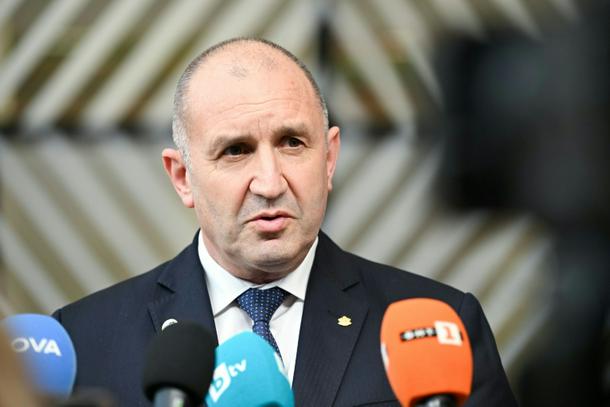
Bulgaria's Prime Minister Rumen Radev said the drone was carrying a 'significant' amount of explosives
Sofia (Bulgaria) (AFP) - Ukraine on Saturday denied targeting Bulgaria after a drone exploded close to the strategic Trans-Balkan gas pipeline linking Turkey to Ukraine near the Romanian border.
Bulgaria’s defence ministry said the drone was of a type “widely used by the Ukrainian military”, and the foreign minister summoned the Ukrainian ambassador for a meeting on Monday in response, her office told AFP.
Kyiv said it was “in close contact with the Bulgarian side to clarify the circumstances” of the incident, the latest case of a drone straying into NATO airspace as Ukraine fights off Russia’s invasion.
“We can say with certainty that the Ukrainian Armed Forces did not intentionally direct any assets toward Bulgaria,” Ukraine’s foreign ministry spokesman Georgiy Tykhyi said, blaming Russia’s invasion for the incident.
While the explosion caused no casualties, Bulgarian Prime Minister Rumen Radev said the amount of explosives it was carrying was “significant”.
“The drone exploded in the immediate vicinity of the Kardam border-crossing with Romania,” near the Black Sea in the country’s northeast, “1,000 metres from the Trans-Balkan gas pipeline’s compressor station,” he said in a video released by the government.
After analysing the debris from the crash, Bulgaria’s defence ministry however said that “currently, nothing suggests that this was a deliberate incident”.
The drone eventually crashed into a sunflower field, Radev said.
- A ‘loud explosion’ -
Romania border police recorded the sound of the drone, then a Bulgarian border police patrol spotted “a loud explosion accompanied by black smoke”, Radev added, speaking after an extraordinary meeting of his cabinet’s security council.
“One thing is certain: the drone was carrying a significant amount of explosives, given that it could be heard from a distance and produced such black smoke,” he said.
The drone had not been detected by either of the two neighbouring countries, he said, adding: “As you know, identifying and neutralising these drones poses a major challenge.”
Incidents involving drones have become increasingly frequent in recent months across eastern European countries that are NATO members and supporters of Ukraine in its conflict with Russia.
Romania has faced frequent drone incursions since the start of Russia’s full-scale invasion of Ukraine in 2022 – – including some crashes on its territory. It ordered the expulsion of a Russian embassy staff member in late July.
Radev said that, following the latest incident, Bulgaria had boosted its surveillance and would redeploy troops and soldiers to the borders to detect drones and employ anti-drone measures.
- Several recent incidents -
Bulgaria, Romania and Turkey all front onto the Black Sea, an arena of drone combat by both Ukraine and Russia which has seen attacks on civilian sihps.
Turkey’s foreign minister on Saturday called for a “moratorium” on attacks by Russia and Ukraine in the body of water in an interview with Turkey’s state news agency Anadolu.
“To begin with, they targeted the ports and the military ships,” said Hakan Fidan. “Now, they are attacking all commercial shipping without distinction.”
Turkey had already on Tuesday denounced Black Sea drone attacks on two Turkish civilian vessels the previous day, in which some crew members were injured.
Bulgaria in June halted its military aid to Ukraine. Radev said the country did not belong in the coalition of Kyiv’s allies supplying arms and that he preferred to see diplomatic efforts to end the war.
Further west, a German military operational command spokesman told AFP on Saturday that drones were detected this week above an army installation in western Germany known to house a large underground depot.
Among other armaments, the Mechernich special site is home to parts for US-made Patriot air-defence systems long coveted by Kyiv.
Those sightings came days after an explosives-laden drone was found near a Ukrainian cargo plane at Leipzig-Halle airport, which plays a key role in the transport of military goods by the German military and NATO allies.